Archives for November 20, 2017

Barry Diller says big media will be ‘serfs on the land’ of tech giants

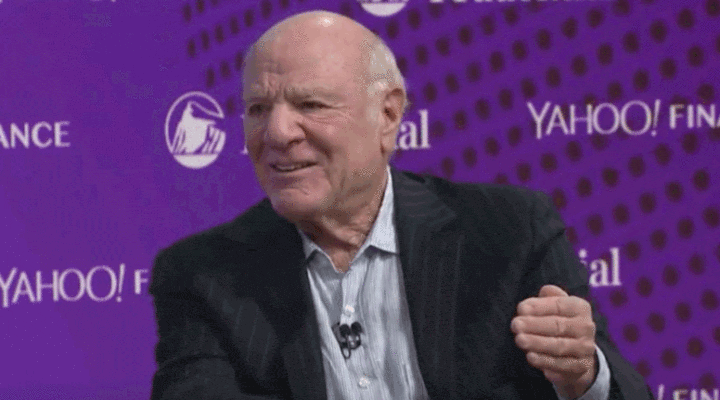
IAC Chairman Barry Diller believes traditional media companies will become serfs to tech giants like Facebook and Google. (Yahoo Finance)

SAN FRANCISCO — The billionaire media mogul behind such popular sites as Expedia, Match.com and HomeAdvisor has a one-word forecast for traditional media conglomerates concerned about being replaced by tech giants: serfdom.

“They, like everyone else, are kind of going to be serfs on the land of the large tech companies,” IAC (IAC) chairman Barry Diller said.

Diller offered that prediction regarding Facebook (FB), Google (GOOGGOOGL) and other pillars of the digital industry at the Virtuous Circle conference put on by a Washington-based trade group, the Internet Association.

The media mogul’s advice to established media firms wondering how to deal with ever-more-powerful tech titans — “You can be a serf on their land!” — may not have been what you’d expect from somebody in his line of work. But it also fits with growing concerns about the reach and influence of those online firms, and what that’s doing to our access to information and entertainment.

He, for one, welcomes our new tech overlords

Monday morning, Diller told CNBC’s Julia Boorstin that the giants of traditional media should accept that their best case is riding off into the sunset and into somebody else’s property.

“They’re not going away, but where they dominated the world of media they will essentially be supplicants… doing okay,” he said.

That’s because Google and Facebook not only have such massive user bases but also dominate online advertising.

“Google and Facebook are consolidating,” Diller said. “They are the only mass advertising mediums we have.”

Another Virtuous Circle speaker, Reddit co-founder Steve Huffman, concurred in an interview with Boorstin later Monday: “Facebook and Google control 90% of the ad market, so you can’t sell ads without competing with Facebook and Google.”

That seems to be an overstatement: In September, the research firm eMarketer calculated that the two would control 63.1% of all digital advertising investment worldwide. That’s an immense amount of power.

Yahoo Finance’s parent group Oath, the media division of Verizon (VZ), is among the firms competing with Facebook and Google.

Regulation may come next

Diller didn’t call these companies evil — he even expressed sympathy for Facebook’s attempts to combat unprecedented, large-scale Russian influence operations. But then he said something surprising.

He expects Facebook, Google and maybe Amazon (AMZN) to face government regulation, simply because of their immense size.

“At a certain point in size, you must,” he said. “It’s inevitable.”

Diller didn’t get into what exact size would qualify a company for this level of regulation, and subsequent Virtuous Circle speakers didn’t offer much more clarity.

“There is probably a point at which big is just too big,” Cox Communications president Pat Esser mused to Axios tech correspondent Ina Friend Monday afternoon. “When is big too big?”

But Diller’s mention of the “extraordinary” $268.9 billion in cash Apple (AAPL) now holds suggested that a company need not dominate online advertising or online retail to earn extra attention from Washington.

He did, however, outline one positive for Big Tech getting so gargantuan. Big Telecom no longer has the economic leverage to roll back today’s net-neutrality norms, in which internet providers don’t try to charge sites extra for access to their subscribers.

“I think it’s hard to overturn practically,” he said. “It is the accepted system.”
Oil markets tepid ahead of Nov. 30 OPEC meeting

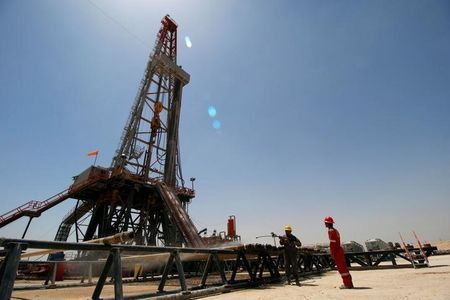
Men work for Iraqi Drilling Company at Rumaila oilfield in Basra
Men work for Iraqi Drilling Company at Rumaila oilfield in Basra, Iraq, May 11, 2017. REUTERS/Essam Al-Sudani

Oil markets were tepid on Monday as traders were reluctant to take on big new positions ahead of an OPEC meeting at the end of the month, when the producer club is expected to decide whether to continue output cuts aimed at propping up prices.

Brent crude futures <LCOc1>, the international benchmark for oil prices, were at $62.56 per barrel at 0439 GMT, down 16 cents, or 0.3 percent, from their last close.

U.S. West Texas Intermediate (WTI) crude futures were at $56.59 a barrel, up 4 cents, or 0.1 percent, from their last settlement.

Traders said they were avoiding taking on large new positions due to uncertainty in markets.

The Organization of the Petroleum Exporting Countries (OPEC), together with a group of non-OPEC producers led by Russia, has been restraining output since the start of this year in a bid to end a global supply overhang and prop up prices.

The deal to curb output is due to expire in March 2018, but OPEC will meet on Nov. 30 to discuss the outlook for the policy.

OPEC is expected to agree an extension of the cut as storage levels remain high despite recent drawdowns, although there are doubts about the willingness of some participants to continue to restrain output.

“(The) OPEC meeting remains the key sector catalyst into year-end … The market expectation is for an extension through 2018, created by OPEC comments early this fall … (but) there is increased risk that OPEC delays the extension decision,” U.S. bank Morgan Stanley said on Monday in a note to clients.

Morgan Stanley said that the question over extended cuts “has shifted to non-OPEC participants’ willingness to extend, primarily Russia”.

Despite this, Greg McKenna of futures brokerage AxiTrader said it was “worth noting data showed more longs added by the speculative community”, indicating expectations of rising prices.

In the United States, the number of rigs drilling for new oil production remained unchanged in the week to Nov. 17, at 738, data from oil services firm Baker Hughes showed on Friday.

Toshiba $5 billion stock issue results in huge dilution but delisting risk removed

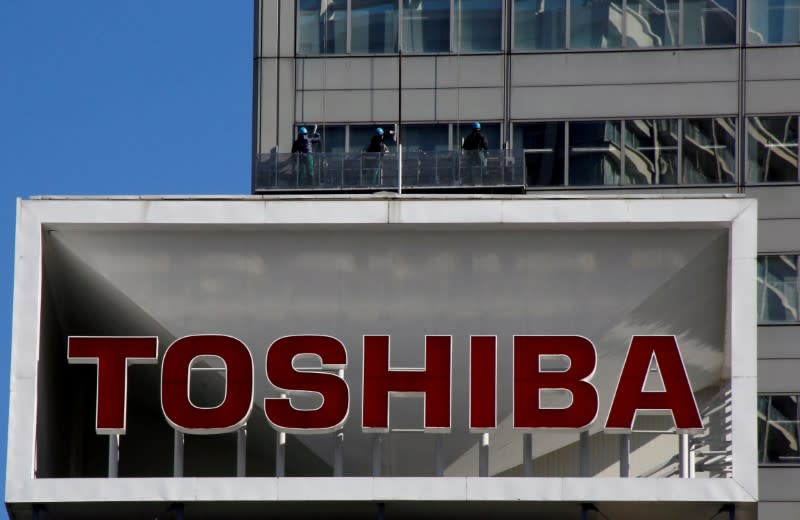
FILE PHOTO: Logo of Toshiba Corp is seen as Window cleaners work on the company's headquarters in Tokyo
FILE PHOTO: The logo of Toshiba Corp is seen as window cleaners work on the company’s headquarters in Tokyo, Japan, February 14, 2017. REUTERS/Toru Hanai/File Photo

Toshiba Corp’s plan to raise some $5.4 billion through a sale of new shares will help it avoid a delisting, but will also see more than 30 overseas investors, including activist funds, own 35 percent of the embattled conglomerate.

The move, decided at a board meeting on Sunday, will allow Toshiba to pay off billions of dollars in liabilities at its bankrupt U.S. nuclear power business, Westinghouse. That in turn gives it the funds to return to positive net worth by the end of the financial year in March, as an $18 billion sale of its prized memory chip unit is unlikely to close before then.

The issue of 2.28 billion new shares at 262.8 yen per share, a 10 percent discount to Friday’s close, will result in a massive 54 percent dilution in earnings per share.

Toshiba’s shares were, however, down just 5 percent in early afternoon trade as the delisting risk was removed and as the capital raising had been expected. The stock was last trading at 277 yen – a level above the sale price.

“Toshiba’s fund raising news eliminates the risk of Toshiba being delisted so that part is positive,” said Takatoshi Itoshima, chief portfolio manager at Commons Asset Management.

“What’s also positive is that the fund raising will improve the company’s financial health. There is an argument that the company will be left with nothing (without the chip business), but it’s good that the company’s capital will recover.”

Third Point LLC, Oasis Management Company and Cerberus Capital Management were among the more than 30 investors which invested through some 60 funds.

Singapore-based fund Effissimo Capital Management, established by former colleagues of Japan’s best-known activist investor, Yoshiaki Murakami, will become the largest shareholder in Toshiba with an 11.34 percent stake.

Payments for the new investment are due to be completed on Dec. 5.

Toshiba also confirmed that it is looking at selling Westinghouse assets.

Sources told Reuters in September that Westinghouse is working with investment bank PJT Partners Inc on a sale process.

Private equity firms Blackstone Group LP and Apollo Global Management LLC have teamed up to bid for the business while Cerberus Capital Management LP was in talks with U.S. nuclear power plant component provider BWX Technologies Inc about submitting a joint bid, the sources said at the time.

Toshiba had initially planned to use funds from the sale of its chip unit to cover its Westinghouse liabilities, but a highly competitive and contentious auction process led to delays in deciding on the buyer and has meant that Toshiba may not obtain the necessary anti-trust clearance by the end of March.

The chip deal still faces legal challenges from its chip joint venture partner Western Digital, which argues no deal can proceed without its consent and has sought an injunction through an international arbitration court.

Toshiba is demanding that Western Digital drop the litigation as a condition over a coming round of a joint investment in Toshiba’s new flash-memory chip production line in Yokkaichi, Japan.

The two companies held talks in the United States last week for settlements, but have yet to agree on details, sources familiar with the matter said.

(This story adds dropped word “than” in first paragraph, clarifies number of investors in paragraph 7.)

Abu Dhabi’s Adnoc to Sell Up to 20% of Fuel-Station Unit in IPO

Abu Dhabi's Adnoc to Sell Up to 20% of Fuel-Station Unit in IPO
An employee uses a fuel pump to fill a customer’s vehicle with unleaded petrol in Dubai, United Arab Emirates, on Monday, July 4, 2011. Abu Dhabi National Oil Co., known as Adnoc, may take over petrol stations owned by Emirates National Oil Co. and Emirates Petroleum Products Co. in the northern emirates, Gulf News said, citing sources it didn’t identify. Photographer: Gabriela Maj

Abu Dhabi National Oil Co. plans to sell as much as a fifth of its distribution unit via an initial public offering on the local stock exchange.

The state-owned crude producer will offer 1.25 billion to 2.5 billion shares of its fuel-station business on the Abu Dhabi Securities Exchange, it said in an advertisement published in Gulf News on Monday. The price range for the sale will be announced on Nov. 26.

With global crude prices at about half of their 2014 average, energy companies and state producers alike are seeking to trim costs and boost efficiency. Adnoc pumps most of the crude in the United Arab Emirates, a member of the Organization of Petroleum Exporting Countries that accounts for about 6 percent of global reserves.

More from Bloomberg.com: Merkel’s Attempt to Form a New German Government Collapses

The proposed share offering follows Emaar Properties raising $1.3 billion from the IPO of its unit in Dubai earlier this month. Adnoc may seek a valuation of $10 billion to $14 billion for the distribution unit, people familiar with the matter said earlier this month.

S&P 500 Futures Fall As Merkel Coalition Talks Fail; Marvell-Cavium Near $6 Billion Deal

utures for the S&P 500 index futures fell modestly early Monday morning after German coalition talks broke down, putting into doubt the future of long-running Chancellor Angela Merkel. Meanwhile, Marvell Technology (MRVL) reportedly is near a deal to buy fellow Cavium (CAVM) for $6 billion as chip takeover buzz has heated up with Broadcom (AVGO) making a $130 billion overture to  Qualcomm (QCOM).

S&P 500 futures fell 0.3% vs. fair value. So did Dow and Nasdaq 100 futures.

German Talks

Month-long talks on forming a new German government collapsed Sunday night, as the Free Democratic Party walked out. Merkel’s Christian Democrat Party, along with Bavarian CSU sistery party, were trying to form a coalition with the Free Democrats and the Green Party.

Merkel could try to form another grand coalition with the Social Democratic Party, but SPD leaders say they aren’t interested in continuing to be the junior partner.

The euro fell on the news from Germany, the European Union’s largest economy.

Chip M&A

Marvell Technology is near a deal to pay about $6 billion for Cavium, or at least $80 a share in cash and stock, the Wall Street Journal and Reuters reported. That would be at least 17% more than what Cavium was trading at in early November when the WSJ first reported on talks.

The companies reportedly will announce the deal as soon as Monday.

The Marvell-Cavium deal talks come as Broadcom recently offered $130 billion for fellow wireless chipmaker Qualcomm. Qualcomm has rejected the offer as undervaluing the company. Both Broadcom and Qualcomm are suppliers to the Apple (AAPL) iPhone.