Archives for October 29, 2017

Opinion: Trump-Ryan tax plan will encourage more corporate offshore tax avoidance

Shifting to a territorial tax is the wrong move

American companies have sheltered about $2.6 trillion in profits overseas to lessen their tax bill. These are the ones with the largest amounts.

One of the big flaws in the U.S. corporate income tax is that it encourages companies to shift revenue, profit, operations, investment and employment to other countries. The Republicans say a big benefit of their tax reform plan is that it would stop companies from doing that.

But the Republicans are wrong. Their plan would do a bit — but not enough — to discourage American companies from continuing to use tax gimmicks to avoid U.S. taxes by pretending that they earn their profits in other countries. And it wouldn’t do much to discourage companies from shifting their investment, employment and operations out of the United States, or giving up their U.S. residence through a corporate ownership inversion.

In fact, the Republican plan could make it easier.

Everyone on both sides of the aisle agrees that the U.S. corporate tax system needs to be reformed, because the current worldwide system encourages a lot of economically wasteful tax avoidance. We need a fair tax system that will raise significant revenue without harming American businesses or the U.S. economy. It’s not an easy task.

But while the Trump-Ryan plan would lower the corporate rate to 20% from 35% and establish a territorial tax system, it wouldn’t do much to stop the tax-avoidance gimmicks. Why? Because there would still be an incentive to shift profits to countries that have a tax rate that’s even lower.

Just last week, House Speaker Paul Ryan argued that the 20% rate would have prevented an American company, Assurant, from moving its legal headquarters to Bermuda, which doesn’t impose any corporate income tax at all.

But the last I checked, 20% is higher than 0%. The Trump-Ryan plan wouldn’t eliminate the incentive for U.S. companies to shift their operations or to shift their profits using creative transfer pricing techniques.

Nearly every tax expert who’s studied this issue agrees that the problem identified by Ryan would remain even after his bill is approved.

William Gale, co-director of the nonpartisan Tax Policy Center, says the Republicans’ unified framework “would encourage [U.S. companies] to ship jobs, capital, and profits overseas.” Similarly, Donald Marples and Jane Gravelle of the Congressional Research Service concluded that proposals like the Trump-Ryan plan “could worsen the profit-shifting that already exists among multinational firms.”

Edward Kleinbard argues that the territorial tax system of Trump-Ryan would reward successful transfer-pricing gamers as “instant winners” of the tax lottery.

Here’s how this works: U.S. corporations have sheltered more than $2.6 trillion in offshore profits, much of it booked in dubious foreign subsidiaries that are largely an accounting fiction. A lot of these profits are earned on work that’s done in the United States, but the profits are attributed to a foreign subsidiary to avoid taxes. The U.S. Treasury loses more than $100 billion a year, according to Kimberly Clausing’s research.

U.S. tech and pharmaceutical companies have been particularly aggressive in fictional accounting that attributes ownership of the company’s intellectual property — patents, copyrights and trade secrets — to a foreign subsidiary located in a low-tax country. Using transfer prices between units of the same company, revenue and profits earned by the company can be transferred to the foreign subsidiary for tax purposes.

The federal tax that is owed on these profits is deferred as long as the corporation doesn’t “repatriate” the funds into the U.S.

In practice, corporations are able to use these accumulated profits indirectly for almost any purpose, without legally repatriating them and triggering the tax. The funds aren’t “trapped” overseas. The hoard of cash overseas isn’t preventing any company from investing in America.

The figures are staggering. At least 366 of the Fortune 500 companies have established subsidiaries in tax-haven countries. The companies pay an average tax rate of 6.1% on their “foreign” earnings, evading a cumulative $750 billion in federal taxes, according to a study by the Institute on Taxation and Economic Policy.

Some of these foreign subsidiaries are legitimate businesses, with actual operations that produce actual goods and services. But many are an accounting fiction, created for the sole purpose of evading taxes. For instance, U.S. companies claim to earn profits in Bermuda that are 18 times larger than the island’s gross domestic product.

These U.S. companies claim to earn 43% of their foreign profits in just five tax-haven countries — Bermuda, Ireland, Luxembourg, the Netherlands and Switzerland — yet these five countries employ just 4% of these companies’ foreign workers and have only 7% of their foreign investments.

Apple AAPL, +3.58%  has sheltered more money aboard than any other, about $250 billion, allowing it to evade paying $77 billion in taxes to Uncle Sam.

According to a Senate investigation, Apple structured two subsidies in Ireland in a way that shielded it from paying taxes to either the U.S. or Ireland. The European Commission found that Apple’s creative accounting allowed the world’s most profitable company to pay a tax rate of just 0.005% on its 2014 European earnings, and ordered Apple to pay $14.5 billion in taxes to Ireland.

The Trump administration claims the Trump-Ryan plan would reduce the incentives to create these fictional subsidiaries because it would reduce the U.S. statutory rate to 20%. With a lower U.S. rate, companies wouldn’t save as much money as before by setting up a post-office box in a tax haven.

But as the Apple example shows, even Ireland’s 12.5% tax rate won’t keep companies from trying to shelter their income.

Nothing in the Trump-Ryan plan would prevent this kind of monumental tax dodging. In fact, it would tell corporations to go right ahead.

Instead of closing this loophole, the Trump-Ryan tax plan would attempt to force companies to pay a one-time “repatriation tax,” a tiny fraction of what they now owe. Going forward, the Trump-Ryan plan would establish a territorial tax system, inviting corporations to earn as much income as they can in foreign jurisdictions and never pay any U.S. tax on it.

Moving to a territorial tax system is the wrong move. The original House Republican tax plan had a better idea: Taxing corporate income based on the location of sales, not location of ownership. That’s the system most U.S. states use to tax corporate income within their borders. But powerful corporate interests killed that idea because it would have hurt some companies, especially retailers.

Since we can only manage to reform the corporate tax system once every 30 years ago, it’s important that we get this right now. We must make sure that all corporations, no matter where they are based, pay their fair share of taxes.

Google Pixel 2 and Pixel 2 XL review: Android phones done right

The Pixel 2 XL is the best representation of Google’s Android you can buy.

When Google (GOOG, GOOGL) launched its Pixel and Pixel XL last year, the search giant proved that it could create hardware that was every bit as good as Samsung’s and Apple’s offerings.

A year later, Google is back with the appropriately named Pixel 2 ($649) and Pixel 2 XL ($849). And not only do the phones address my biggest complaint about their predecessors — yep, they’re now waterproof — they may just be the best phones on the market.

Two-for-one special

Like last year, Google’s Pixel 2 comes in two flavors. But now the tech giant is offering them in a 5-inch model and a larger 6-inch XL version. But while the original Pixels were more or less identical, save for the XL’s larger size, the Pixel 2 and 2 XL are very different.

The Pixel 2 is more or less a clone of the original Pixel. It sports a 5-inch display with thick bezels along its top and bottom edges. The Pixel 2 XL, on the other hand, eschews those bezels for a nearly edge-to-edge display.

The Pixel 2 and Pixel 2 XL are designed for those who want a smaller handset or a big-screen device.

Around back, however, both phones look the same. They share the original Pixel’s two-tone design, with glass panels on the top portion of the phones and rear-mounted fingerprint readers. The Pixels don’t, however, come with any kind of facial-recognition technology, which Samsung offers on the Note 8 and Apple will include on the upcoming iPhone X.

Oh, and both phones can now survive a dip in up to 3 feet of water for 30 minutes without giving up the ghost. That’s a huge improvement over the original Pixels.

Screen choice

While the Pixel 2 and Pixel 2 XL have different size screens, they both use the same display technology. The Pixel 2 comes with a 1,920 x 1,080 resolution AMOLED panel, while the 2 XL has a 2,880 x 1,440 resolution AMOLED display.

Interestingly, my Pixel 2’s screen had a warmer, yellow tint, while the Pixel 2 XL’s screen had a cooler, blue tint. The difference isn’t noticeable when you view the phones separately, but when you look at them at the same time, it’s pretty obvious.

The Pixel 2 XL’s display is cooler than the iPhone 8 Plus’, but offers brilliant colors.

Between the Galaxy Note 8iPhone 8 Plus and Pixel 2 XL, the Note 8 seems to lean toward cooler colors, while the iPhone favors warmer hues. The Pixel 2 XL seems to split the difference between the two.

Despite the fact that the Pixel 2’s panel looked warmer than the 2 XL’s, it still wasn’t as warm as the iPhone’s, though it was certainly not as cool as the Galaxy S8’s.

Camera performance

While Samsung (SSNLF) and Apple (AAPL) have stratified their smartphones’ camera abilities by adding dual-lens setups to their more expensive models, Google has opted to equip both the Pixel 2 and Pixel 2 XL with the same single-lens cameras. That’s a bit of a bummer, since Samsung and Apple use their dual-lens cameras to provide users with the ability to optically zoom in on subjects.

Still, that doesn’t mean the Pixel 2 and Pixel 2 XL are slouches when it comes to general photography. DxOMark, an independent image benchmarking firm, gave the Pixel 2’s camera its highest rating, something Google was sure to brag about during the phones’ debuts.

The Pixel 2 and Pixel 2 XL share the same excellent cameras.

Photos taken with the Note 8 did tend to offer more exaggerated colors, while the Pixel 2 and iPhone 8 plus looked more natural. I also liked low-light photos taken with the Pixel better than those taken with the iPhone 8 Plus, but when I used the flash, the iPhone 8 came out on top. All three cameras had trouble balancing out darker skin tones against bright clothing.

The Pixel 2 captures clean images in low-light settings.

Despite the Pixel 2’s lack of a dual-lens camera, Google still managed to integrate the now-popular portrait mode into its handsets. The feature, which creates a bokeh effect that blurs the background while leaving the foreground in focus, looked fantastic on the Pixel 2. Google says that’s because it uses “split” pixels and machine learning to achieve the effect.

The Pixel 2’s images generally looked more true-to-life than the Galaxy Note 8’s shots.

In my tests, the feature worked better with the Pixel 2 than Samsung’s Galaxy Note 8, as the Note 8 had some trouble distinguishing between certain background objects and the foreground.

Google Lens

One of the most helpful features of the Pixel’s camera is the addition of Google Lens. Using machine learning, Lens can pull out specific information from a photo such as phone numbers, addresses, names, landmarks, art and media.

I took a picture of my landlord’s information while leaving my building one morning and Lens pulled out the address and phone number, making it incredibly easy for me to quickly call and complain about the pounding on the wall next door.

Google Lens can analyze images and identify their subjects, as well as pull text from them.

Lens was also able to recognize the text in a photo of a sign for Hai Street Kitchen & Co. and provide me with relevant search results, including the eatery’s nearest locations.

Samsung’s Bixby offers similar functionality, but when I took a photo of the same sign, it was unable to provide me with search results and instead offered shopping options for large signs, language translation and images with similar fonts.

Give it a squeeze

The Pixel 2 comes loaded with the latest version of Google’s Android operating system, Android 8.0 Oreo. The Pixel 2 and Pixel 2 XL are considered pure Android phones, as they don’t run any additional apps than those included in Android. They also receive updates sooner than Android phones from the likes of Samsung and LG.

Of course, Google has worked to ensure that its Google Assistant is baked directly into the Pixel 2. Using a new feature called Active Edge, you can squeeze the sides of the Pixel to instantly bring up Assistant. You can also squeeze to silence calls and allow it to open Assistant even when the screen is off.

Speaking of which, the Pixel 2 and Pixel 2 XL feature always-in displays, which show you recent notifications in white text against a black background when the screen is locked and off. This is also where Google’s Now Playing option lives.

The feature, which is turned on by default, listens for sounds playing nearby and can identify them and display them on the lock screen. I had trouble getting it to work well, though, as it took several seconds to identify some songs and couldn’t identify others.

Power and performance

Both the Pixel 2 and Pixel 2 XL come loaded with octa-core Qualcomm Snapdragon 835 processors, 4GB of RAM and 32GB or 128GB of storage. Both handsets have more than enough battery life to last you through the day and fast-charging adapters to top off the tank when they’re running low.

Unfortunately, Google has joined the growing number of smartphone manufacturers that have done away with headphone jacks. Instead, you’ll have to use either the USB C to 3.5mm adapter included in the box or buy a USB C-compatible headset.

Apple took a lot of heat for just this decision when it launched its iPhone 7, but to the company’s credit, it included a Lighting-compatible headset with the phone. Google does not.

Should you get it?

I was a big fan of the original Pixel and the addition of waterproofing and improved cameras have me sold on the Pixel 2 and Pixel 2 XL. I’m particularly fond of the Pixel 2 XL thanks to its gorgeous design. I do wish the Now Playing option was more consistent and am disappointed that Google is making consumers switch to USB C headphones without including them in the box like Apple.

Still, if you want to avoid the iPhone and you’re sick of Samsung, the Pixel 2 and Pixel 2 XL are the ones to get.

Samsung North America CEO believes we’ll soon talk to all of our appliances

Samsung (SSNLF) wants you to talk to your phone more. Not in the traditional sense of calling someone, but rather by chatting directly with your handset via its Bixby voice assistant. Launched on the company’s Galaxy S8, Bixby got off to a rough start. It lacked voice recognition out of the box and wouldn’t gain the feature until months after its debut.

But Tim Baxter, president and CEO of Samsung North America, believes the company’s assistant will power nearly all of its devices going forward.

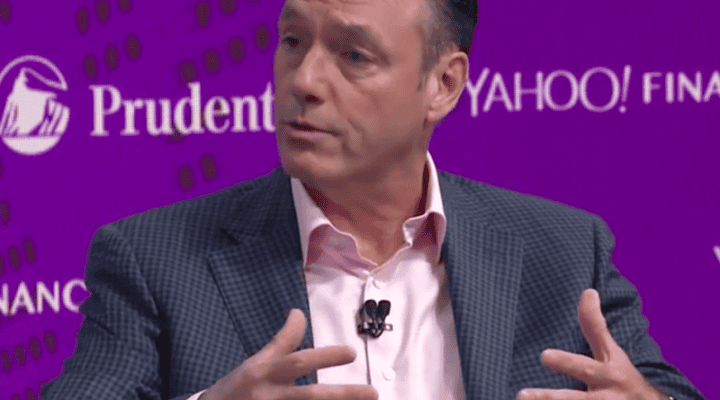
“We just announced last week at our developers conference what we call Bixby 2.0, which now brings this user interface not only in the phone, but in our televisions and appliances and other devices,” he said at Yahoo Finance’s All Markets Summit. “And we think that will create new multi-device experiences and new benefits for consumers.”

Tim Baxter, president and ceo of Samsung North America, speaks at the Yahoo Finance All Markets Summit.

Baxter envisions an ecosystem of Bixby-enabled devices across consumers’ homes. So if you want to see what’s in your refrigerator, you’ll be able to ask Bixby and you’ll get a view of your old milk on your smartphone.

That’s not just a pipe dream, either. Samsung Vice President Eui-Suk Chung laid out a similar scenario in a blog post announcing Bixby 2.0 last week.

“We see a world where digital assistants play a bigger role, an intelligent role, where one day everything from our phones, to our fridge, to our sprinkler system will have some sort of intelligence to help us seamlessly interact with all the technology we use each day,” Chung wrote.

Bixby’s biggest competitors, though, are heavyweights like Amazon’s (AMZN) Alexa, Google’s (GOOG, GOOGL) Assistant and Apple’s (AAPL) Siri. Baxter, however, points out that Bixby was designed specifically to interact with Samsung devices rather than serve as a means to search the web or purchase items online.

“Samsung is coming at it from, ‘How do I utilize the technology and benefits in the device using a new UI and using voice?’ So, the ability to communicate directly to your device to learn more about it,” he said.

“The phones we have are more and more complex, there is more and more power in it … So why not have machine learning do that and intuitively just say ‘Take a selfie, post it on Instagram,’ or, ‘Shut down for the night and have my phone go into mute, have my alarm set for 6 a.m., have the phone go into a lighter tone brightness on i.’ ”

Bixby is still hobbled by the fact that the assistant doesn’t have the kind of intelligence that Google’s Assistant or Amazon’s Alexa currently offer. In time, though, the software could become more knowledgeable and eventually rival its chief competitors — but for now we’ll have to wait and see.

Inside the Amazon company that’s even bigger than Amazon.com

Everybody knows what “the cloud” is, right? It’s, like, internet storage or something? Sure. Yeah.

I wanted to go a little deeper. I wanted to know exactly what it is, where it is, who owns it, who runs it, and how it works. So I did a little travel, conducted some interviews—and last Sunday, “CBS Sunday Morning” aired my story. You can watch it here.

The “who runs it” part has a particularly interesting answer. In large part, the answer to that is, “Amazon” (AMZN), which reports earnings on Thursday.

Over the last decade, Amazon has quietly built up the world’s largest cloud-services company, called AWS (Amazon Web Services). In terms of income and profit, it’s much bigger than Amazon.com (the division that sells stuff by mail-order).

It’s also much bigger than its rivals, which include Microsoft (MSFT), IBM (IBM), and Google (GOOGGOOGL); in fact, AWS says that it’s bigger than its next 14 competitors combined.

Most companies don’t like to reveal what cloud-services company they use, but here are a few companies that don’t mind saying that they run on AWS: Hulu, Netflix, Comcast, Spotify, Pinterest, Yelp, Airbnb, Slack, PBS, SmugMug, Hertz, Time, Intuit, Unilever, Zillow, Dow Jones, Morningstar, Under Armour, Kellogg’s, Expedia, Adobe, Philips, GE, Shell, AOL, BMW, Canon, Capital One, IMDb, Johnson & Johnson, Lamborghini, Lyft, McDonald’s, NASA, Novartis, Pfizer, Philips, Samsung, SAP, Sony, SoundCloud, Ticketmaster, and the US Department of State.

For the TV story, I had the rare opportunity to interview an Amazon executive: Dr. Matt Wood. His current title is general manager for artificial intelligence AWS, but he’s been part of AWS from the beginning. (I asked him if the “Dr.” meant medical doctor or PhD doctor. In Wood’s case, both. He started his career as a medical doctor.)

As always happens, though, the time constraints of TV meant that not all of the good stuff from our interview made it into the broadcast. So here, for your reading pleasure, is a more complete edited transcript of my interview with Dr. Wood.

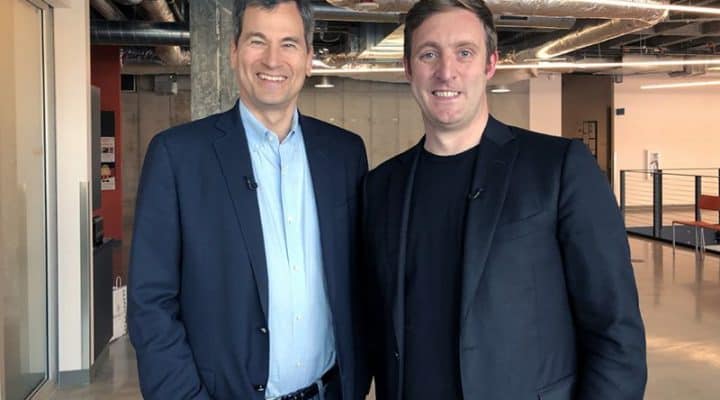
Dr. Matt Wood (right) joined me for a “CBS Sunday Morning” interview at Amazon’s Seattle headquarters.

POGUE: Because AWS caters to businesses, not ordinary consumers, most consumers haven’t heard of it. But it’s giant, right?

WOOD: It’s a relatively large business today. We’re a little over $16 billion in revenue run rate [projected income for 2017], and we’re growing at just over 40% a year.

POGUE: So who had the foresight, when AWS started, to say, “You know what could be really a good business for us…?”

WOOD: It actually came out of Amazon retail. The developers inside Amazon retail wanted to be able to move more quickly. They were frustrated about having to write big checks [to buy new server equipment] and wait and wait and wait [for them to be delivered], and do all this extra work to be able to try out their idea.

And so we started to come up with some ideas about how we could make that faster. And so we started to explore an entirely new business for us, selling these services to businesses in the same way as Amazon was consuming them.

POGUE: So all of these companies are hiring AWS to do what?

WOOD: They are able to pull down computational power as if it was a utility.

So let’s say you’re a brewery, right? They don’t want to manage computers. They want to brew beer. They don’t want to be going through the expense and the upfront cost and all the complexity of managing these large amounts of computers.

POGUE: So it sounds like cloud companies like AWS are basically renting computers, storage, power, security—all the stuff that technicians would have normally had to do on site, right?

WOOD: That’s right, yes.

AWS is relatively unknown to consumers—but it’s by far the largest piece of Amazon.

POGUE: Are you also saying there was a time before cloud companies when people did all this stuff in house?

WOOD: Yeah. People often talk about the “heavy lifting” of building web applications or mobile applications. Well, back when I was doing my Ph.D., we were given the task—a group of Ph.D. students—to move a mainframe computer from one room to another.

This thing weighed — it must have been several tons. It took about eight wimpy nerds to try to lift it. We dropped it, and it got stuck in the doorway. (LAUGH) We had to get the university football team to come in and help us move it out of the way before our professors came back and found us!

POGUE: (Laugh) Literal heavy lifting!

WOOD: So it’s not like that today. All I need is an AWS account and a credit card, and I can start trying out new ideas, for pennies.

And larger organizations find the same benefits. And so today, very large organizations such as, you know, GE, Shell, Phillips, Netflix, all run on top of AWS.

POGUE: Really? Netflix?

WOOD: Yes.

POGUE: Wait. Amazon has a very similar business—Amazon Prime Video. Why would Netflix hire its arch-rival to store and serve up its movies?

WOOD: Well, that’s a good question. It’s one that Netflix asked us very early on. (LAUGH) From the very first day of AWS, we set up the company as a separate business. We have a separate management chain; we are situated in a separate building.

We even wanted companies that could potentially compete with Amazon.com—our cousins at retail—to be able to use the same platform. And so to AWS, Amazon.com is just another customer.

POGUE: Is there a downside to the cloud idea? Is there any reason that somebody might shy away from structuring their data this way?

WOOD: The only reason I can really think of is that some companies have already made those very, very large investments in their own data centers. They’ve signed the checks, they’ve done the waiting, they’ve racked and stacked their service. And so they’ve already made that investment.

POGUE: So suppose I’m one of these companies who’s got an existing computer setup, and I want to move to AWS…

WOOD: Yeah. There’s a couple of ways that you can do that. You can just upload it as normal. But sometimes you have so much data [that it would take forever to transmit electronically]. So we built this device–the Snowball.

(He shows me a suitcase-size, gray, plastic-enclosed case.)

The AWS Snowball can be a faster, cheaper way to send a company’s data to Amazon than uploading it.

POGUE: Snowball, you call it?

WOOD: It’s 100 terabytes of storage. And you just connect this up to your data center, load your data on. And then you just physically ship it back to us, and then we load it into the cloud from our data center.

POGUE: Ship it, like through FedEx or UPS or something—

WOOD: Exactly. You should never underestimate the bandwidth of a FedEx truck. (LAUGH) In fact, right on the front here, you can see that we have an e-ink display—basically, a Kindle—which shows the customer’s address when we ship it out to them. And then as soon as they arrive and plug it in, [the address on that screen changes to show] our data center collection location, and you just ship it back to us.

POGUE: Oh, this—this is a screen, this is not paper—

WOOD: Exactly, yes. Because we didn’t want the shipping labels to come off in transit.

POGUE: So essentially, this is like a giant shippable hard drive. Can you track it?

WOOD: Yeah; it has 3G, Wifi, and also a GPS system.

POGUE: But hard drives are delicate. What if the shipper guy drops it?

WOOD:  We built them to be robust and ruggedized. We actually built them to military specifications. We put them on a boat in the middle of a lake and then exploded depth charges around the boat and then made sure they could still work.

POGUE:  Can it handle a drop to concrete?

WOOD:  Easily, no worries.

POGUE:  Like this?  (I shoved the Snowball off the table onto the concrete floor, where it just bounced and then lay flat) It’s okay, folks! It doesn’t have a scratch on it. I don’t know about the floor, though.

WOOD: (LAUGHS)

How AWS handles security

POGUE: OK, we gotta talk about security. I imagine you have a huge staff of experts?

WOOD: Yeah. I mean, security really is job zero for us. We take it extremely seriously. It’s the first thing that we think about when we get up in the morning, it’s the last thing we think about when we go to bed.

POGUE: Because “the cloud” actually resides in data centers—huge, unmarked buildings running thousands of servers. And one AWS data center may house the livelihoods of a bunch of companies, all concentrated in one building.

WOOD: Actually, we don’t even store all of the data in one place. We don’t have a single data center. We use groups of data centers. And those groups of data centers are separated by large distances. They’re on separate floodplains and fault lines. We move data automatically between the data centers in those groups. And that means the data is always backed up, not just inside a data center or between data centers, but between groups of data centers in different physical locations.

POGUE: So I don’t mean to give anyone ideas, but let’s say I figured out that one of these unmarked buildings was an AWS data center, and I blew it up. Are you saying that it’s so backed up and redundant that you probably wouldn’t notice?

WOOD: Yeah, you wouldn’t notice. I mean, we might be a bit upset, but you wouldn’t notice.

POGUE: That leads into my other question, which is that 70% of the cloud, 70% of the world’s internet traffic, flows through data centers in Loudoun County, Virginia. Should we be worried about that concentration?

70 percent of the world’s Internet data flows through the massive data centers in Loudon County, Virginia. (CBS News)

WOOD: No, that data is backed up across multiple different physical locations. And we do that to limit the blast radius. If something does happen, or we have a power event, or there’s a flood in one specific location, that data is held redundantly in other locations, as well. So the cloud just keeps running.

POGUE: How is each physical AWS data center protected?

WOOD: The first thing is that we control personnel extremely tightly. So although I’ve been at Amazon nearly 10 years, I’ve never visited one of our data centers. I’ve never stepped foot inside them. I don’t even know their addresses.

POGUE: Because you’re not allowed to?

WOOD: Because I’m not allowed to, yeah. I don’t have any reason to be there. And a data center’s primary vector of insecurity is physical attacks. So you don’t want people there that don’t need to be there.

Beyond that, obviously we have all of the controls—the concrete, the guards, the bars—to prevent and mediate and evaluate physical access to the security. If you don’t need to be in there, you don’t get in.

POGUE: One of the data center managers told me that one reason we’ve never heard of terrorists attacking a data center is that they’re interested in terror—and that’s attacking people, not things. That a data center is just a bunch of machinery that’s easily repaired and replaced.

WOOD: Easily repaired, easily replaced, and can cause no disruption whatsoever.

POGUE: What about hacks? You know, Equifax, Sony, and other big companies being hacked. Does that have anything to do with the cloud and the way it’s structured?

WOOD: Only in that we provide developers the tools to prevent these sorts of attacks. So you can go in and very quickly protect all of your data. You can encrypt all of your data. And we even provide machine learning tools that evaluate the risk associated with your data.

So we can identify, with customers’ permission, a difference between a webpage, which is OK to deliver, or Social Security numbers and personally identifiable information. And then we continuously monitor for differences in how that data is accessed. And if we find an anomalous access, then we alert both automatic remediation and people, so they can go investigate.

POGUE: Then how do these hacks happen?

WOOD: In a variety of ways. The most common way is social engineering—trying to figure out someone’s password through nefarious processes. So calling up and saying that you are the telephone operator and you’re asking for their password, for example, and then the person just giving it to you. So it’s much more common for those sorts of attacks to be propagated.

POGUE: So the weak link turns out to be us.

WOOD: As it so often is.

Disappearing Bank Jobs Won’t Be Coming Back, Nordea CEO Says

  • The CEO predicts there’ll be half as many bankers in 10 years
  • Nordea says it’s leading a mass industry metamorphosis

The 6,000 job cuts announced last week at Nordea Bank AB are just a down payment for an industry facing radical overhaul, says Chief Executive Officer Casper von Koskull.

“If somebody says, where are we, or where are banks, 10 years from now, banks could easily have half what they have today,” in terms of personnel, von Koskull said in an interview in London on Friday.

Nordea last week stunned unions, analysts and investors when it revealed the staff reductions, which amount to well over a tenth of the work force of the Swedish bank. Unions called the step “shocking” and “brutal.”

The industry is already a lot leaner than it was before the financial crisis. The European Banking Federation estimates there are about 14 percent fewer people in finance in the region than before 2008. There are now about 2.8 million people in Europe working at banks. Nordea had about 31,500 employees in the third quarter.

Von Koskull says what Nordea is doing represents the future of banking. While speaking to analysts in London last week, he described a universe in which only the leanest, most digitally advanced and efficient banks will thrive. Firms living in the banking dark ages are already failing, he said.

“The fact that some banks — not this bank — have been technically insolvent every 15 years, that really does not mean that they are resilient,” he said. “Resilience is something that this industry, and any bank, needs. And that is something that we have been building. And resilience is not only about capital, resilience is your operations, your systems, and everything you do.”

While the upfront expense of such a transformation isn’t small, von Koskull says the bank will soon be using a lot less of its income to cover costs. The ratio of Nordea’s costs to its income was 51 in the third quarter. Von Koskull says that number will be in the “lower 40s” when the bank has transformed itself.

The Nordea CEO told Bloomberg that he views his bank as a pioneer in how it’s looking at the fundamental shifts now gripping the industry.

“We are maybe one of the first ones,” he said. “This is not a cost cut, per se, it is a way of doing business differently, where you need less people.”

He said complaints from unions are hard to understand. “They know” what’s coming, he said. “We’ve been talking about it for two years.”

“I think it’s very clear that it’s an ongoing trend in the financial industry, given that this is an industry that is very digital,” von Koskull said. “You can digitize and use AI in a very big way. Combined, of course, with a personal touch.”

JPMorgan Asset Doesn’t Think Much of Taiwan’s Stock Rally

JPMorgan Asset Doesn’t Think Much of Taiwan’s Stock Rally

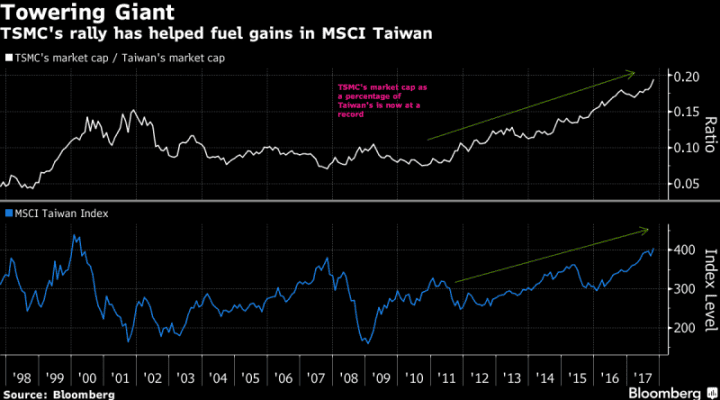
Outside of megacap Taiwan Semiconductor Manufacturing Co., Taiwan’s equity universe looks increasingly unappealing to  Howard Wang.

Wang, who oversees JPMorgan Asset Management’s Greater China fund, has cut its Taiwan holdings to 18 percent of the total from 25 percent two years ago, even as the island’s shares rallied. Almost half of that allocation is TSMC, which makes chips for companies such as Apple Inc.

“We’ve gotten to the stage where other than TSMC, Taiwan has really hit a plateau,” Hong Kong-based Wang said in an interview. “You have a very export-driven economy whose currency just appreciated 7 percent this year against the dollar — that’s not very helpful. You also have an aging workforce and I think something that can’t be quantified is corporate fatigue in Taiwan. I see too many Chinese companies gaining market share from Taiwanese competitors.”

With a market capitalization of $205 billion, TSMC is one of the world’s largest companies. It alone accounts for more than half of the MSCI Taiwan Index’s 45 percent advance since January 2016. The shares trade near a record high, even as concern over demand for Apple’s products weighs on other suppliers. Foreign investors own 80 percent of the stock.

While jitters over Apple sales spurred net outflows of $2.2 billion from Taiwan equities last quarter, the island’s shares remain a favorite destination for international funds. For the year, inflows stand at $8.4 billion, the most among 10 Asian markets tracked by Bloomberg. A tax benefit means Taiwanese shares also tend to pay higher dividends — another draw for investors.

There are still areas where Taiwan can win, said Wang, the former head of Goldman Sachs Group Inc.’s Taiwan office. JPMorgan Asset’s Taiwan fund favors stocks in export niches such as high-end auto parts, textiles and precision components, he said.

“Taiwan has the ability to do a lot of workshop, high-complexity type of items and do those well,” he said. “When Taiwanese companies are in spaces where you can apply a lot of capital, a lot of cheap labor, they’re just getting slaughtered right now by the Chinese.”