Archives for July 16, 2017

GM teams up with Uber to expand Maven program to Australia

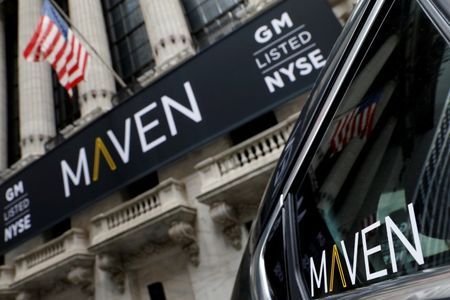
A sign for General Motors Co. car-sharing operation, Maven hangs on the facade of the New York Stock Exchange (NYSE) in New York
A sign for General Motors Co. car-sharing operation, Maven hangs on the facade of the New York Stock Exchange (NYSE) in New York, U.S., May 15, 2017. REUTERS/Brendan McDermid

SYDNEY (Reuters) – General Motors Co said on Saturday it was testing its car-sharing operation, Maven, in Australia through a pilot program with ride-hailing company Uber Technologies Inc [UBER.UL].

The leasing agreement will allow Uber drivers to rent cars produced by GM’s Australian manufacturer GM Holden, the company said.

“We are testing the adoption of one Maven product – Maven Gig – in Australia through a pilot program in Sydney renting Holden cars to Uber drivers,” Sean Poppitt, communications director at GM Holden, said in a statement.

GM’s Maven Gig program is aimed at helping drivers rent a car on demand for independent gigs such as package delivery, food or grocery delivery, and ridesharing, at a time when more people are expected to take up freelance work.

It is currently operational in San Diego and set to be launched in San Francisco and Los Angeles later this year, GM said in May.

GM announced a similar North American partnership with Uber in November last year.

A spokesman for Uber was not immediately available for comment.

(Reporting by Harry Pearl; Editing by Jacqueline Wong)

IPOs This Week: 5 Companies Seek Nearly $1 Billion in Capital

Both initial public offerings (IPOs) on last week’s calendar succeeded in entering the public markets and another five are on the calendar for the coming week. Last week’s capital raise of about $132 million is dwarfed by the $966 million being sought in the week ahead.

Of last week’s IPOs, Akcea Therapeutics Inc. (AKCA) raised $125 million in an upsized offering of 15.6 million shares at a reduced price of $8 a share. The stock got a first-day pop of 18.5% on Friday.

Co-Diagnostics Inc. (CODX) raised $7 million with a downsized offering of 1.2 million shares at $6 a share, below the expected range of $6.35 to $6.75. Shares closed the week essentially flat.

Through the week ending July 14 IPO ETF manager Renaissance Capital reported that 79 IPOs have priced in the U.S. so far this year, up nearly 80% year over year. Total proceeds raised through last week equaled $20.6 billion, up 182% year over year. For 2016, Renaissance Capital reported a total of 105 IPOs, down 38% year over year from 170 in 2015. Total 2016 proceeds amounted to $18.8 billion compared with a 2015 total of $30 billion. Renaissance Capital does not include “best efforts” or blank-check companies in its totals, nor does it include IPOs that raise less than $10 million.

First out of the gate this week is Calyxt Inc., a spin-off of Cellectis (CLLS), that develops gene-edited crop traits. The company plans to offer 6.1 million shares in an expected price range of $15 to $18 to raise $100 million at an implied market cap of $440 million. Underwriters are Citi, Jefferies, Wells Fargo Securities, BMO Capital Markets, and Ladenburg Thalmann & Co. Shares are expected to price Wednesday and begin trading Thursday on the Nasdaq under the ticker symbol CLXT.

Federal Street Acquisition Corp. is a blank-check company that plans to acquire a healthcare business. The firm is offering 40 million units at a price of $10. Each unit consists of one share of Class A common stock and one-half of one warrant to purchase further shares at a price of $11.50 within five years. Underwriters for the offering are Citi and BofA/Merrill Lynch. Units begin trading Thursday on the Nasdaq under the ticker symbol FSACU.

Kala Pharmaceuticals Inc. is a biopharmaceutical company using proprietary technology to focus on treatment of eye diseases. The firm plans to offer 6 million shares in an expected price range of $14 to $16 to raise $90 million at an implied market cap of $349 million. Underwriters include J.P. Morgan, BofA/Merrill Lynch, Wells Fargo Securities, and Wedbush PacGrow. Shares are set to price Wednesday and begin trading Thursday on the Nasdaq under the ticker symbol KALA.

TPG RE Finance Trust Inc. is a commercial real-estate finance company. The company plans to offer 11 million shares in an expected price range of $20 to $21 to raise $226 million at an implied market cap of $1.22 billion. Underwriters include BofA/Merrill Lynch, Citi, Goldman Sachs, Wells Fargo Securities, Deutsche Bank, J.P. Morgan, Morgan Stanley, Barclays, TPG Capital BD, and JMP Securities. Shares are expected to price Wednesday and begin trading Thursday on the New York Stock Exchange under the ticker symbol TRTX.

YogaWorks Inc. is a national, multi-discipline yoga instruction company. The company plans to offer 5 million shares in an expected price range of $12 to $14 to raise $65 million at an implied market cap of $181 million. Underwriters include Cowen & Co., Stephens Inc., Guggenheim Securities, Roth Capital, and Imperial Capital. Shares are expected to price Wednesday and begin trading Thursday on the Nasdaq under the ticker symbol YOGA.

PetIQ Inc. is manufacturer and distributor of health and wellness products for dogs and cats. The company plans to sell 5.7 million shares in an expected price range of $14 to $16 to raise $85 million at an implied market cap of $302 million. Underwriters are Jefferies, William Blair, Oppenheimer & Co., Raymond James, and SunTrust Robinson Humphrey. Shares are scheduled to price Thursday and begin trading Friday on the Nasdaq under the ticker symbol PETQ.

A ruling against Google in Canada could affect free speech around the world

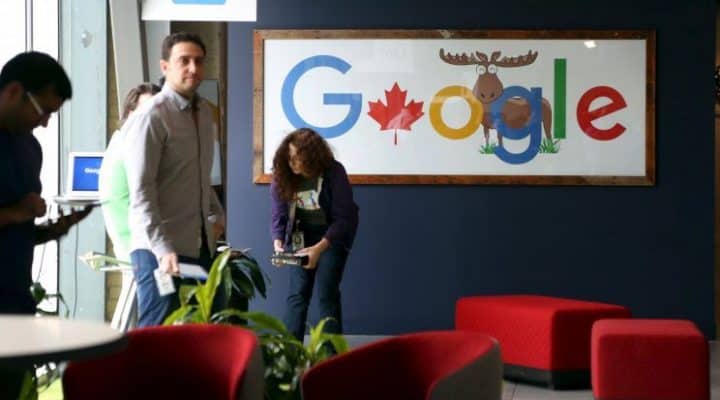
Google's Canadian engineering headquarters in Kitchener-Waterloo, Ontario seen on January 14, 2016. (Reuters)
Google’s Canadian engineering headquarters in Kitchener-Waterloo, Ontario seen on January 14, 2016. (Reuters)

The Supreme Court of Canada issued an order to Google Wednesday: Stop showing search results for a company accused of fraud, not just in Canada, but throughout the world. Yes, that includes everybody reading this in America.

But the court’s ruling that the Alphabet. Inc., (GOOG, GOOGL) search subsidiary “de-index” the company could also invite other courts — including those in countries not as nice as Canada — to issue their own global takedown demands for other sites, which can easily lead to free speech being squashed.

And U.S. companies that want to do business in those other nations will have little choice but to comply. Too bad, eh?

Litigate locally, punish globally

This story started with a lawsuit filed by Barnaby, British Columbia-based Industrial-networking vendor Equustek Solutions Inc., alleging that a competitor, Datalink Technologies Gateways Inc., had started selling its technology as its own.

A lower court told Datalink to knock it off, but the firm then fled the province to “an unknown location” while continuing to hawk its wares online.

Equustek asked Google to stop sending people to Datalink’s sales pages, and Google complied. But as Datalink kept moving the offending sales pitch from one page to another, Equustek asked Google to stop pointing people to Datalink’s site entirely — and to do the same around the world.

An appeals court granted that request, and Canada’s Supreme Court upheld that while rejecting free-speech arguments in a 7-2 ruling.

“This is not an order to remove speech that, on its face, engages freedom of expression values, it is an order to de-index websites that are in violation of several court orders,” Justice Rosalie Abella wrote. “We have not, to date, accepted that freedom of expression requires the facilitation of the unlawful sale of goods.”

Google’s press office released a statement in response: “We are carefully reviewing the Court’s findings and evaluating our next steps.”

Corporations versus governments

The traditional view of trying to keep something off the internet, as Electronic Frontier Foundation co-founder John Gilmore points out is, “The Net interprets censorship as damage and routes around it.”

But multinational corporations, unlike internet packets, operate in fixed locations. They have employees that can be arrested, assets that can be seized and bank accounts that can be hit with fines.

Having any one country tell a company doing business there that it must take something offline within that country has always been a risk, and sometimes tech firms have opted not to run accept such demands — Google’s decision to pull out of the booming Chinese market over government censorship is a perfect example of this.

But Canada’s Supreme Court has flipped this script with its globally-binding ruling. Daphne Keller, a director of Stanford University’s Center for Internet and Society, called it “much more far reaching than most” in an email.

And the underlying offense here, an intellectual-property violation, is far from being something everybody can agree on as being beyond the pale worldwide. Said Keller: “I am in tons of discussions about this, and the one point of consensus is global removal of child pornography.”

Further, this isn’t just any rogue judicial body engaging in global grandstanding. “The Canadian Supreme Court is well respected around the world, and this ruling will carry some weight elsewhere,” emailed Michael Geist, a law professor at the University of Ottawa.

Geist, who had earlier urged the court to adopt a narrower remedy, said the judges should have limited their ruling to Google’s google.ca Canadian site.

Everybody loses

The court’s ruling is a mess all around. It won’t actually solve the problem of people finding undesirable content online for the same reasons that the European Union’s “right to be forgotten” doctrine can’t.

Like the EU’s “RtbF,” Canada’s ruling doesn’t encompass every search engine and says nothing about social media, with its proven ability to send massive amounts of people to a site. Nor can it stop individual people or sites from pointing to offending pages — something that can become more likely after a dose of publicity.

The problem looms much larger for everybody else online. Canadian judges may be a reasonable lot, but if they see fit to assert global jurisdiction, so can any other country’s judges.

Microsoft Surface Laptop review: A great notebook with one small flaw

The back-to-school shopping season is just around the corner, and Microsoft (MSFT) is hoping its new Surface Laptop will be the computer you or your child brings to the classroom.

Starting at $999, the Surface Laptop is Microsoft’s attempt to fight back against the growing popularity of Google’s (GOOGGOOGL) low-cost Chromebooks and Apple’s (AAPL) own MacBook line. It’s a beautiful, lightweight device and packs a powerful battery.

The Surface Laptop also marks the debut of Microsoft’s new Windows 10 S operating system, a more security- and performance-minded variant of Windows 10. Unfortunately, to get those features, you also have to sacrifice some of your independence when it comes to what you can put on your own computer.

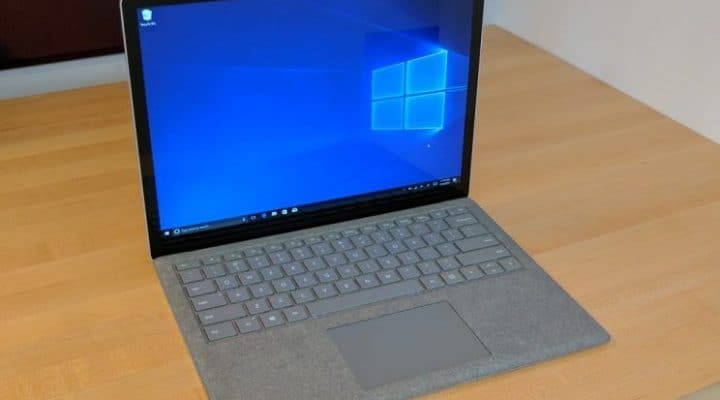
The Microsoft Surface laptop.
Microsoft’s Surface Laptop is one of the best on the market.

You’ve gone soft on us

The Surface Laptop follows the same design language as Microsoft’s Surface Pro and Surface Book. But unlike its stablemates which are only available in “platinum,” the Laptop is available in blue, red and gold, as well.

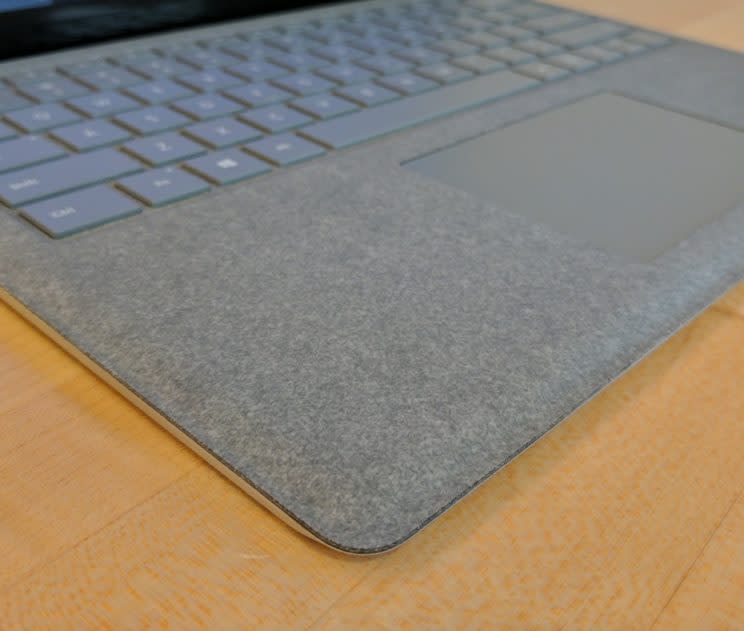
The colors aren’t the only new addition to the Surface Laptop, though. Microsoft has also covered the notebook’s keyboard deck with the same Alcantara fabric found on its Surface Pro Signature Type Cover. Seeing fabric on a laptop is certainly jarring at first, but it actually makes for a more comfortable typing experience than the Surface Book and MacBook’s traditional keyboard decks.

Microsoft's Surface Laptop sports Alcantara.
Microsoft has covered the Surface Laptop in Alcantara fabric.

Naturally, the first question everyone, including me, asks when seeing the fabric, though is: “What happens if you spill something on it?”

Microsoft says as long as you wipe down your Surface Laptop it should be completely fine. Alcantara, as Microsoft will remind you, is the same fabric used in high-end luxury cars. It’s basically a more durable, synthetic version of suede, so you shouldn’t have to worry about damaging it with a few drops of coffee here and there.

The Surface Laptop's soft Alcantara.
The Laptop’s Alcantara is incredible soft.

Screen envy

Microsoft’s Surface products have some of the most attractive displays on the market, so it only makes sense that the Surface Laptop would sport a similarly beautiful panel. At 13.5 inches, the laptop’s touch screen is slightly larger than the MacBook Air’s 13.3-inch non-touch panel, and offers a higher resolution of 2256 x 1504 pixels versus the Air’s 1440 x 900 pixels.

The standard MacBook, on the other hand, has a gorgeous 12-inch Retina HD panel with a 2304 x 1440 resolution. The MacBook Pro, meanwhile, gets a 13.3-inch Retina HD screen with a 2560 x 1600 resolution.

Windows 10 S

Here’s where things get a little tricky for the Surface Laptop. Instead of loading the Surface Laptop with Windows 10 Home or Windows 10 Pro, Microsoft ships the Surface Laptop with a new version of its operating system called Windows 10 S.

Warren Buffett Just Gave Away Almost $3.2 Billion — Here’s Why

Berkshire Hathaway (NYSE:BRK-A) (NYSE:BRK-B) CEO Warren Buffett has just given away 18.63 million Class “B” shares of his stock, worth nearly $3.2 billion as of this writing. However, this is nothing new: Buffett has given away more than $27.5 billion since 2006. Here are the details about Buffett’s charitable efforts, who’s getting the money, and other billionaires who have decided to follow Buffett’s lead.

Buffett’s charitable pledge

It may surprise you to learn that Warren Buffett has pledged to give away virtually all of his wealth. Buffett originally announced in 2006 that he intended to gradually give away all of his Berkshire Hathaway stock to philanthropic organizations. More than 99% of his wealth will be given away, both during and after his lifetime.

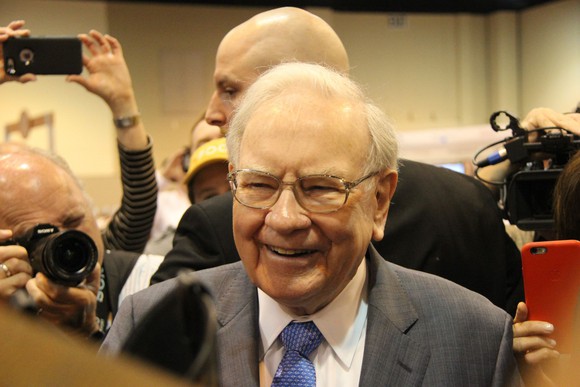
Warren Buffett at Berkshire Hathaway's annual meeting.

IMAGE SOURCE: THE MOTLEY FOOL.

Buffett has decided to give away about 4% of his remaining Berkshire Hathaway shares every year while he’s still alive, and has already given away about 40% of the Berkshire stock he originally held — including his 2017 donation. It’s Buffett’s wish that his money be used for current needs, not held in endowments. After Buffett is gone, he wants the remainder of his Berkshire shares to be completely spent on charitable purposes within 10 years of his estate’s settlement.

To be clear, the 1% of Buffett’s wealth he’s not giving away is still an amount in the hundreds of millions of dollars, so his wife and children will be well taken care of after he’s gone. He says that his children have already been given considerable sums of money and will receive more.

In 2010, Buffett, along with his longtime friends Bill and Melinda Gates, announced The Giving Pledge, in which they formally announced plans to distribute the bulk of their wealth to charity, and encouraged other billionaires to do the same. In Buffett’s pledge letter, he said:

Were we [Buffett and his family] to use more than 1% of my claim checks on ourselves, neither our happiness nor our well-being would be enhanced. In contrast, that remaining 99% can have a huge effect on the health and welfare of others. That reality sets an obvious course for me and my family: Keep all we can conceivably need and distribute the rest to society, for its needs.

It’s also worth mentioning that Buffett makes other donations to charity, as well. For example, he auctions off a lunch with himself every year to benefit one of his late wife’s favorite charities, and bids typically go into the millions.

Buffett’s latest donation and where it’s going

In July 2017, Buffett donated 18.63 million Class “B” shares of his Berkshire Hathaway stock, which was worth about $3.17 billion at the time the gift was made. The donation is being distributed to the Bill & Melinda Gates Foundation, which will receive about $2.42 billion, as well as four family charities:

  • The Susan Thompson Buffett foundation, which is named for Buffett’s late first wife.
  • The Howard G. Buffett Foundation, overseen by Buffett’s son Howard.
  • The Sherwood Foundation, overseen by Buffett’s daughter Susan.
  • The NoVo Foundation, overseen by Buffett’s son Peter.

After the donation, Buffett still owns about 17% of Berkshire’s outstanding shares and remains the world’s fourth-richest person.

Sprint Stock Jumps on Report That Its Chairman Held Meetings With Warren Buffett and John Malone

Sprint Corp.’s (S) Chairman Masayoshi Son met separately with Berkshire Hathaway’s (BRK.A)  Warren Buffett and cable and media tycoon John Malone, possibly concerning an investment in the telecom company, according to the Wall Street Journal, sending the stock jumping 4.3% to $8.55 by Friday’s close.

Though the details of the meeting have not been disclosed, the Journal reported that there is a possibility that Berkshire could invest as much as $10 billion in a potential transaction concerning the company.

Son, who owns 80% of Sprint, has been active in merger talks for the money-losing company in recent months, including a public courtship of mobile rival T-Mobile U.S. Inc. (TMUS).

More issues for food makers: As if food makers such as Kraft Heinz (KHC) and grocery retailers like Kroger (KR) and Walmart (WMT) didn’t have enough issues on their plate thanks to Amazon’s (AMZN) advances.

A significant demographic headwind could add further pressure on the packaged food and grocery store sectors in the years ahead, according to Wolfe Research analyst Scott Mnushkin. The U.S. government reported recently that the fertility rate in the U.S. (births per 1,000 women) hit a record low of 62.0 in 2016, with the number of births down about 1% from the prior year. With births declining and immigration slowing, population growth in the U.S. has stalled.

For the aforementioned sectors, Mnushkin points out, it’s critical households are formed in order for demand to materialize. The fact that’s not happening at a decent clip is troublesome.