Archives for May 29, 2017

Evergrande’s Boss Got $10 Billion Richer on Meteoric Share Surge

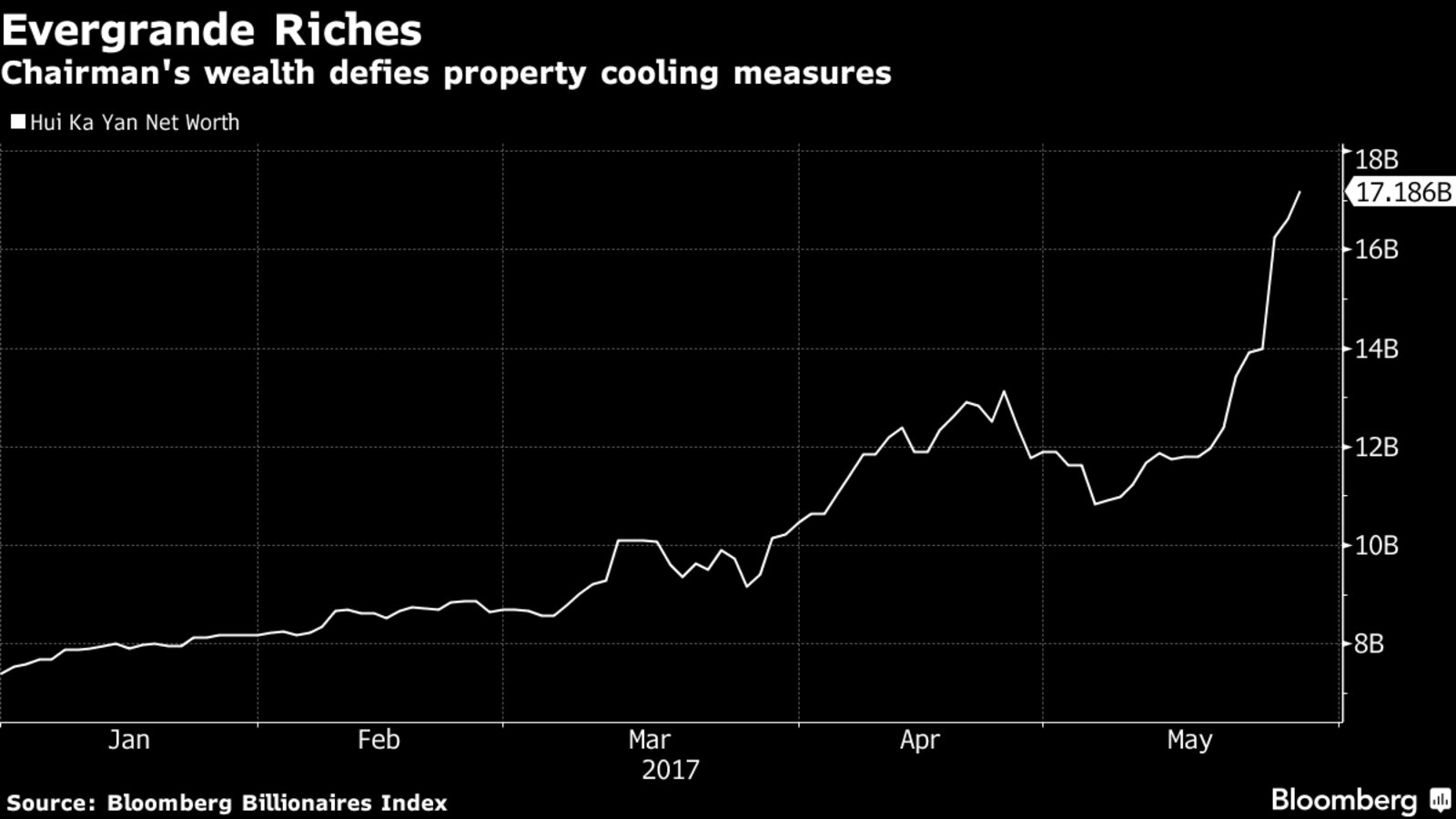
  • Hui Ka Yan’s wealth jumps more than 132 percent this year
  • Evergrande has soared on buybacks, speculation of rising sales

Hui Ka Yan

Hui Ka Yan. Photographer: Anthony Kwan/Bloomberg

Hui Ka Yan, chairman of China Evergrande Group, has seen his fortune surge by at least $10 billion this year as shares of his property company have almost tripled.

Hui’s net worth jumped 132 percent to reach 17.2 billion, making him the sixth-richest person in China, according to the Bloomberg Billionaires Index, which doesn’t reflect a jump in shares in Hong Kong on Monday. The shares rose 17 percent to HK$14.52 at 11:07 a.m.

Don’t miss: Cannabis is saving lives and changing the medical world – This company is a sure bet

Evergrande’s shares have been on an unstoppable rally this year, fueled by a string of buybacks and speculation that some developers will benefit from rising home sales in smaller cities amid restrictions in larger metropolises. Evergrande’s increase, though, has exceeded the forecasts of even the most bullish stock analysts tracked by Bloomberg after ranking as the top performer in the MSCI Asia Pacific Index this year.
Hui’s relative wealth gain is the second-largest in Asia this year, behind only Wang Wei whose net worth jumped 373 percent after his S.F. Holding went public in Shenzhen through a backdoor listing, according to data compiled by Bloomberg. Hui’s riches rose faster this year than those of billionaires such as Larry Page and Sergey Brin, the co-founders of Alphabet Inc., and Microsoft Inc.’s Bill Gates.
In April, Chinese authorities stepped up restrictions in a string of large cities to rein in home prices. New-home prices, excluding government-subsidized housing, gained last month in 58 of the 70 cities tracked by the government. Property prices in third-tier Chinese cities accelerated gains in April, while those in first-tier cities slowed.

Also see: Is this the end to banking as we know it?

Stocks Climb in Korea, Japan; Dollar Reverses Loss: Markets Wrap

  • U.K., U.S., China markets closed for holidays on Monday
  • Dollar reverses losses amid Fed official’s rates comments

Stocks in Japan and South Korea climbed amid low trading volume and the dollar erased losses as Federal Reserve Bank of San Francisco President John Williams said the economy is strong enough to withstand three or four interest rate increases this year.

The Kospi index headed for a fresh record and Tokyo shares were buoyed as the yen gave up early gains. The rand pared its advance after South African President Jacob Zuma survived a bid by some members of the African National Congress’s top leadership to order his removal from office. Markets are closed in the U.S., the U.K. and China. North Korea fired another missile, which appears to be a Scud variant.

Also read: Bullfrog Gold Raises $816,000 Of Equity To Advance Its Nevada Gold Project

A six-week surge in global equities pushed stocks to a record high as investors bet global economic growth can withstand higher U.S. interest rates as soon as next month. While stocks have recovered from worries surrounding the prospects for President Donald Trump’s reform policies, 10-year Treasuries are on course for a fourth monthly advance amid concern inflation is lagging expectations.

Disagreement on the strength of the U.S. comes as the first hints of China’s economic performance in May suggest that a slowdown in growth is taking hold as policy makers beef up efforts to clamp down on financial risks.

Don’t miss: Cannabis is saving lives and changing the medical world – This company is a sure bet

“The U.S. economy is about as close to the Fed’s dual mandate goals as we’ve ever been,” Williams said in remarks prepared for delivery in Singapore on Monday. “With the attainment of our dual mandate goals close at hand, it’s more important than ever for monetary policy to work toward what I like to call a ‘Goldilocks economy’ -– an economy that doesn’t run too hot or too cold.”

Williams doesn’t vote on monetary policy this year, but he worked closely with Fed Chair Janet Yellen when she led the San Francisco Fed and he was its director of research, and is seen as an influential voice at the central bank.

Why one hedge-fund titan is bracing for ‘all hell to break loose’ in the stock market

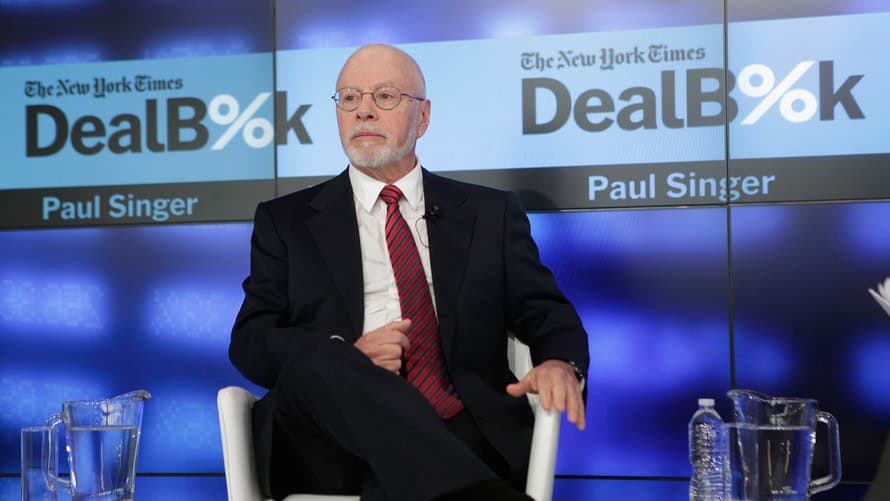
Paul Singer of Elliott Management isn’t sure exactly what hell on Earth, or Wall Street, will look like, but he’s got billions stockpiled for when it does

Paul Singer

Some say the world will end in fire, but hedge-fund honcho Paul Singer wants to be ready to pick up the pieces.

Billionaire investor Paul Singer has a bleak outlook for Wall Street, and he has built a $5 billion rainy-day fund in preparation for what he describes as “all hell” to break out.

Singer, who runs $33 billion hedge fund Elliot Management, wrote in a recent letter to investors that a bout of protracted low volatility and a tendency of stocks to levitate higher is likely to lead to near-term carnage in financial markets:

Here’s how Singer puts it:

Given groupthink and the determination of policy makers to do ‘whatever it takes’ to prevent the next market ‘crash,’ we think that the low-volatility levitation magic act of stocks and bonds will exist until the disenchanting moment when it does not. And then all hell will break loose (don’t ask us what hell looks like …), a lamentable scenario that will nevertheless present opportunities that are likely to be both extraordinary and ephemeral. The only way to take advantage of those opportunities is to have ready access to capital.

The hedge-fund manager has raised some $5 billion in recent weeks, according to Reuters, that he says will be put to work when investor confidence finally gets brought to its knees. He raised the sum in about 24 hours, the report indicated.

Don’t miss: Cannabis is saving lives and changing the medical world – This company is a sure bet

Lately, the stock market has been stubbornly buoyant.

After buckling under mounting worries about President Donald Trump’s White House and alarming allegations about Russia’s connection to members of the president’s administration, resulting in the worst single-session drop in 2017, equity-index gauges have rebounded higher.

On Friday, the S&P 500 index SPX, and the Nasdaq Composite Index COMP, registered records on the same day for the second consecutive session, while the Dow Jones Industrial Average DJIA, closed out the week just 35 points short of its own all-time high. This equity action came as the CBOE Volatility Index VIX, otherwise known as Wall Street’s “fear gauge,” finished in single-digit territory for only the 13th time in its history, booking its fifth lowest close ever. That is way below the VIX’s long-term average of 20 and comes after the index—used to bet on market swings a month in the future—closed at 15.59 on May 17, the same day appetite for risk went on hiatus.

Also see: Is this the end to banking as we know it?

Skeptics of Wall Street’s recent rally, which has been borne on the hope of pro-growth promises from Trump coming to into full view sooner than later, predict that an inevitable failure of the president to make good on his policy promises could jolt markets violently lower.

Singer is among those fearing that very scenario. He is betting that an economic recession may be on the horizon and believes that, with interest rates already near ultralow levels, the Federal Reserve won’t be able to provide a sufficient quantitative-easing cushion, as it did during the 2008-’09 financial crisis.

How to make sure you never run out of money

Business Insider first reported on Singer’s letter on May 24 followed by CNBC late Friday.

It is worth noting that Singer, who had been a prominent Trump critic, has met face-to-face with the president in the White House and, according to reports, donated money to his Jan. 20 inauguration.

Also read: Bullfrog Gold Raises $816,000 Of Equity To Advance Its Nevada Gold Project

To be sure, Singer’s doomsday radar hasn’t always been accurate, nor it has been very early. The hedge-fund investor in 2008 said Fed monetary policies and QE programs would supercharge inflation, or rising prices, and damage the U.S. economy.

So far, inflation has been relatively benign and the economy seems to be on a steady footing, albeit muted, growth footing.

But understanding how so-called smart-money investors, like Singer, may be positioning themselves during a period in which investors are incessantly on edge about ever-rising stock valuations and less-than stellar economic reports can be useful.

Bottled water is now more popular than soda — why you should avoid both

U.S. consumers spent $21 billion on bottled water last year

bottled water

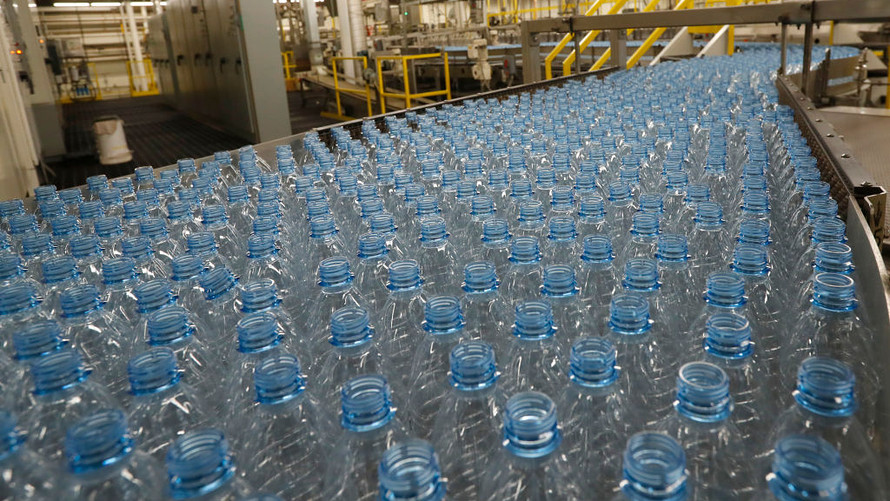
Bottled-water consumption in the U.S. hit 39.3 gallons per capita last year, while carbonated soft drinks fell to 38.5 gallons.

Americans now drink more bottled water than soda, but some environmentalists say it’s worth highlighting there’s a hidden cost to buying all those plastic bottles.

Bottled-water consumption in the U.S. hit 39.3 gallons per capita last year, while carbonated soft drinks fell to 38.5 gallons, marking the first time that soda was knocked off the top spot, according to recent data from industry tracker Beverage Marketing Corp. But soda is still more expensive, racking up $39.5 billion in retail sales versus $21.3 billion for water, industry research group Euromonitor found. “In 2016, bottled water overtook carbonates to become the leading soft drinks category in off-trade volume terms, an astonishing milestone a decade in the making,” it said.


While the fizzy soda category has experienced an annual volume sales decline since 2003, bottled water grew every year over the last two decades, except 2009 during the depths of the Great Recession, driven by consumer concerns about the effects of artificial sweeteners and sugar.


While the fizzy soda category has experienced an annual volume sales decline since 2003, bottled water grew every year over the last two decades, except 2009 during the depths of the Great Recession, driven by consumer concerns about the effects of artificial sweeteners and sugar. Bottled water also had another unexpected boost aside from skittishness over sodas. Scares over possible water contamination have helped boost demand for bottled water over the last few decades, experts say.

More than one-quarter of bottled water revenue last year was shared by the soda giants Coca-Cola Co. KO, and PepsiCo PEP, which sell Dasani and Aquafina respectively. In the four decades since the launch of Perrier water in the U.S., consumption of bottled water surged 2,700%, from 354 million gallons in 1976 to 11.7 billion gallons in 2015, according to the International Bottled Water Association.

Don’t miss: Cannabis is saving lives and changing the medical world – This company is a sure bet

And not all European bottled water is always free of chemicals, according to studies of European bottled waters carried out in Germany, Switzerland, Italy and France — one published in 2011 and the other in 2013 — by the Goethe University Frankfurt’s Department of Aquatic Ecotoxicology. Among the main compounds Wagner found: Endocrine disrupting chemicals, or EDCs, which can act like hormones in the body and have been linked to diabetes, breast cancer and cardiovascular disease. (Representatives from the bottled water industry contend that the origin of these EDCs were likely environmental rather than from a packaging material.)

Plastic soda and water bottles are also clogging up landfills and floating as vast vortices on the world’s oceans. What’s more, consumers can purify their own tap water for a fraction of the cost of a $2 bottle of water or soda.

Plastic soda and water bottles are also clogging up landfills and floating as vast vortices on the world’s oceans, studies suggest. Americans discard around 33.6 million tons of plastic each year, but only 6.5% of that recycled and 7.7% is combusted in waste-to-energy facilities, according to Columbia University’s Earth Center. The U.S. was recently ranked 20th among 192 countries that could have contributed to plastic waste in the oceans, according to a 2015 study led by Jenna Jambeck, an environmental engineer at the University of Georgia and published in the academic journal Science.

The industry disagrees. Bottled water containers are 100% recyclable, an International Bottled Water Association spokeswoman said. “The most recent recycling rate for bottled water containers is 35.4% and, of all the drink packaging that is mismanaged, bottled water containers make up just 3.3%,” she said. (Glass containers make up over 66%, soda containers make up more than 13%, and aluminum cans make up nearly 8%, she said. Read more here.)

What’s more, polyethylene terephthalate or PET, plastic bottled water bottles already use less plastic than any other packaged beverage, the International Bottled Water Association spokeswoman added. Between 2000 and 2014, the average weight of a 16.9-ounce (half-liter) PET plastic bottled water container declined 51%, according to the Beverage Marketing Corporation. Another 2015 study estimated that the accumulated number of “microplastic” particles in 2014 weighed between 93,000 and 236,000 metric tons, which is only 1% of global plastic waste estimated to enter the ocean in one year. (Consumers can also purify their own tap water for a fraction of the cost of a $2 bottle of water or soda. Prices start at $5.)

Amid this environmental debate, bottled water has come into its own precisely because of environmental problems elsewhere. Some 700,000 Californians may have been exposed to contaminated water, the California’s Water Resources Control Board recently said. And in Toledo, Ohio in 2014, the Ohio National Guard distributed bottled water to residents due to contaminated water there. A federal state of emergency was declared in Flint, Mich. in January 2016 and residents were told to use bottled water for both drinking and bathing due to faulty and old lead pipes.

Also see: Is this the end to banking as we know it?

But there is some irony for people who believe bottled water is spring water, sourced from some Alpine mountain peak or green meadow: Some 45% of bottled water brands are sourced from the municipal water supply — the same source as what comes out of the tap, according to Peter Gleick, a scientist and author of “Bottled and Sold: The Story Behind Our Obsession with Bottled Water.”

Those within the industry, however, say that does not mean it’s the same as tap water. The spokeswoman for the International Bottled Water Association says purified and spring water must meet Food & Drug Administration quality standards. “When a public water system is used as a source for making purified bottled water, several processes are employed to ensure that it meets comprehensive U.S. Food and Drug Administration regulations,” she says. “These treatments can include ozonation, filtration, reverse osmosis, distillation or de-ionization. The finished water product is then placed in a bottle under sanitary conditions and sold to the consumer.”

(Dasani and Aquafina use a public water source, but both companies say the water is filtered for purity using a “state-of-the-art” process.) And, as the industry expands, more bottled waters are available with different flavors, carbonation and vitamins.

Also read: Bullfrog Gold Raises $816,000 Of Equity To Advance Its Nevada Gold Project

And the alternative seems far worse. Soda and sugary drinks may lead to an estimated 184,000 deaths each year among adults from diabetes, heart disease and other obesity-related illnesses, according to a landmark 2015 study by researchers at Tufts University published in the American Heart Association journal Circulation. The study analyzed consumption patterns from 611,971 individuals between 1980 and 2010 across 51 countries, along with data on national availability of sugar in 187 countries. (The American Beverage Association published a lengthy rebuttal: “The authors themselves acknowledge that they are at best estimating effects of sugar-sweetened beverage consumption.”)

But sugar-shy consumers are shying away from diet soda too. Several recent studies have linked diet soda and cardiovascular disease and showed a correlation (if not a causation) between cancer and aspartame and, on last week, another study argued that diet soda is correlated to dementia and strokes in older people. The American Beverage Association also rejects those studies, highlighting the difference between “correlation” and “causation,” and says people who are overweight and already at risk for heart disease may consume more diet drinks in an attempt to control their weight and the Food and Drug Administration has ruled that artificial sweeteners are safe.

Last year, Pepsi announced that it will sell Diet Pepsi with both aspartame, the diet sweetener typically used in sweeteners like Equal, and sucralose, used in Splenda. Unlike bottled water, however, they’re both artificial.

There’s a 20-year gap in life expectancy for people living in these parts of the U.S.

This is where life expectancy is longest (and shortest) for Americans

life expectancy

‘Geographic disparities in life expectancy among U.S. counties are large and increasing,’ a new study finds. Photo: Kristen Bell in ‘The Lifeguard’ (2013).

How long you live may depend on where you live.

Life expectancy at birth for both sexes combined was 79.1 years overall, but differed by 20.1 years between the counties with the lowest and highest life expectancy, this study, published in Jama — Journal of the American Medical Association this month. What’s more, geographic inequality in life expectancy actually increased between 1980 and 2014. While this inequality in the risk of death fell among children and adolescents during that time, it increased among older adults.

Don’t miss: Cannabis is saving lives and changing the medical world – This company is a sure bet

Several counties in South Dakota and North Dakota — typically those with Native American reservations — had the lowest life expectancy, and counties along the lower half of the Mississippi and in eastern Kentucky and southwestern West Virginia also had very low life expectancy compared with the rest of the U.S. (highlighted in deep red in the map), the study found. In contrast, counties in central Colorado had the highest life expectancies (highlighted in purple, below).

“Geographic disparities in life expectancy among U.S. counties are large and increasing,” the study says. Much of the variation in life expectancy among counties can be explained by a combination of socioeconomic and race/ethnicity factors of the people living in those counties, their nutrition and behavior, income and health care. Government policy targeting these issues may help reverse the trend of increasing disparities in life expectancy in the U.S., it adds.

The researchers from the University of Washington, Seattle used county-level death records from the National Center for Health Statistics (NCHS), which is part of the Centers for Disease Control and Prevention, and population counts from the U.S. Census Bureau, NCHS and the Human Mortality Database, which was created by researchers in the U.S. and Germany to provide detailed mortality and population data to researchers, students, journalists and policy analysts.

Previous analyses of life expectancy at the county level have found large and increasing disparities in how long people lived based on where they actually lived. However, this latest analysis either excluded or combined a large number of smaller counties, “likely leading to an underestimation of geographic inequality,” the researchers said. “Moreover, recent research has highlighted the need to consider age-specific metrics of survival in addition to life expectancy overall.”

Also see: Is this this end to banking as we know it?

A separate 2016 study found that Mississippi’s citizens are the least healthy, followed by Louisiana, Arkansas, Alabama and Oklahoma. In that study, Hawaii ranked as the healthiest state for the fifth consecutive year, followed by Massachusetts, Connecticut, Minnesota and Vermont. Conducted by United Health Foundation, a Minnetonka, Minn.-based nonprofit health care group established by UnitedHealth Group, it looked at the health of U.S. residents at state-level.

Health was measured by behaviors like smoking and excessive drinking, the community and environmental situation — including air pollution and the number of children in poverty — policy issues such as health insurance (or lack thereof), the number of active primary care physicians and public health funding, and health issues such as cancer deaths and diabetes, and clinical care. “The years of potential life lost before age 75 increased for the second consecutive year,” it concluded.