Archives for March 28, 2019

The Air Force is exploring AI-powered autonomous drones
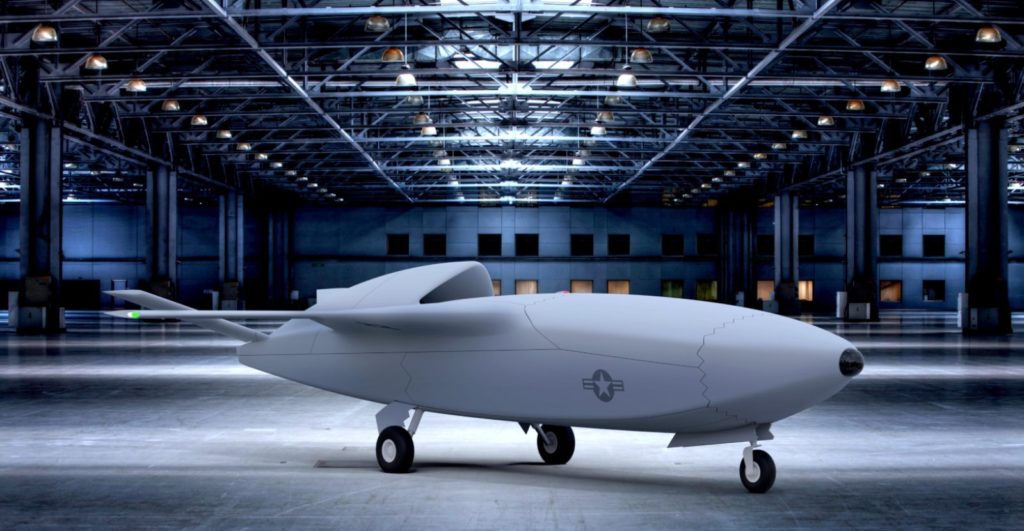
The Skyborg program is still in its early stages.

The Air Force wants to see if AI-powered autonomous drones can help human pilots better perform their mission. In a press release, the Air Force said it was seeking input from the tech industry in a new AI initiative for autonomous drones it calls Skyborg. Still in its planning stages, the Air Force is looking for market research and concept of operations analysis for Skyborg to get a sense of what technologies are out there for such a fleet. It is seeking to launch protoypes of the autonomous drones as early as 2023.

What exactly would the autonomous drones under Skyborg do? According to a request for information filed on March 15, the Air Force wants the system to avoid other aircraft, terrain, obstacles, and hazardous weather. The system should allow drones to take-off and land independently. Skyborg should also be able to be operated by humans with little or no pilot or engineering experience.

The Air Force is also asking for a “separate payload and flight architecture to allow for modular adjustments and adaptability.” In other words, the Skyborg system could ideally use different sensors depending on the mission, such as a camera for a surveillance role or particle detection sensor for detecting air contaminants.

“The primary goal of the Skyborg program is to deploy a modular, fighter-like aircraft that can be used to quickly update and field iteratively more complex autonomy to support the warfighter,” said the request for information.

In short, Skyborg would be to a human pilot like R2D2 is to Skywalker. Will Roper, the Air Force assistant secretary for acquisition, technology and logistics, made the Star Wars reference at a conference earlier this month, reported C4ISRNet. Skyborg could respond to or anticipate a human pilot’s commands. Or a pilot could send Skyborg in their place to an airspace filled with enemy planes and avoid danger.

Skyborg may fuel images of the AI-powered fighter jet in the 2005 military sci-fi film Stealth. But Skyborg’s capability seems to be benign in comparison; the request doesn’t call for weapons. The project is still very much in its early stages. What exactly Skyborg will be able to do, and how, has yet to be decided.

Given the fallout from Project Maven, the Air Force’s latest foray into AI may also ruffle feathers in Silicon Valley. But Skyborg and Project Maven appear to be functionally different projects, at least on the surface. Skyborg uses AI to help military pilots in combat, while much of Project Maven’s criticism was over Google assisting the military in the surveillance of private citizens. If Google does decide to bid for another contract with the Air Force, the decision won’t have been made lightly. Google’s new ethical AI advisory council, which will vet any decisions that Google makes in the AI space, holds its first meeting in April.

Watch Samsung bend the Galaxy Fold hundreds of times
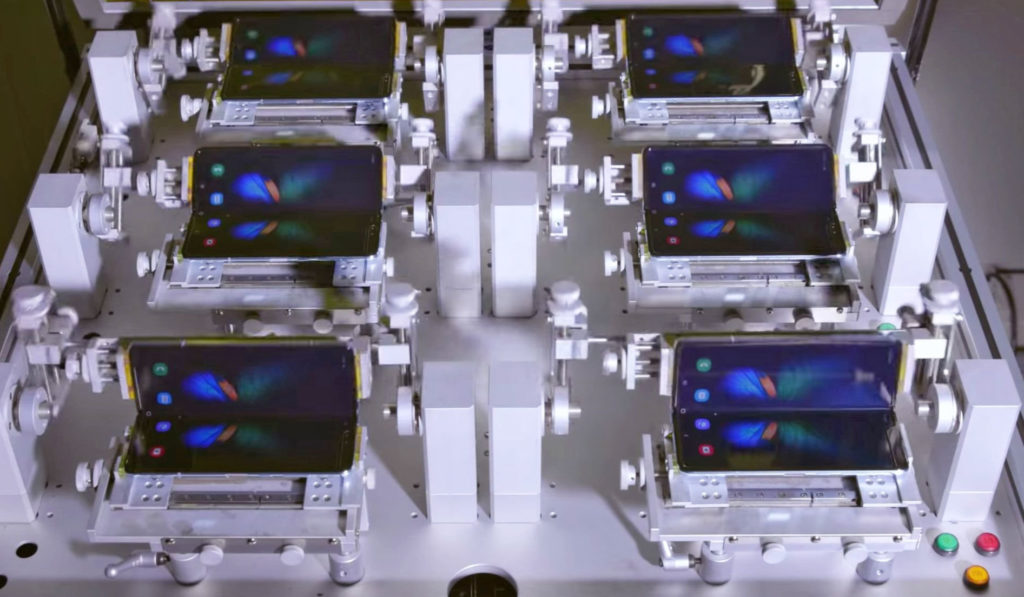
Samsung puts its folding smartphone to the test in a video.

Samsung is attempting to put to rest doubts over the Samsung Galaxy Fold’s durability by revealing how each device is tested. The company released a video on Wednesday that shows its devices undergoing a factory stress-test, where a line-up of brand new Samsung Galaxy Folds fold, and then unfold, and then fold again.

Samsung claims its $2,000 device can withstand at least 200,000 folds and unfolds, which, if you fold it 100 times a day, works out to be about 5 years of use. But the problem doesn’t seem to be simply whether the Samsung Galaxy Fold can fold properly, but whether users can get around two glaring problems with its aesthetics: the fold gap when the device is folded and a display seam when the device is unfolded.

When folded, the two phone parts of the Galaxy Fold sit at roughly an 85-degree angle. This means the display won’t be entirely flat when your folded Galaxy Fold is resting on a desk or another flat surface. Early viewers of the Galaxy Fold have also spied a display crease that appears when the device is unfolded. (You can get a glimpse of the crease in the image below.)

Galaxy Fold

It’s unclear whether such flaws in the device’s display will impact sales, at least at first. Owners may decide the novelty of owning a tablet that doubles as a smartphone outweighs the Samsung Galaxy Fold’s less than immaculate design. The Galaxy Fold will be available for sale in the US on April 26, and pricing starts at $1,980.

You want AIs with that? McDonald’s buys into machine learning
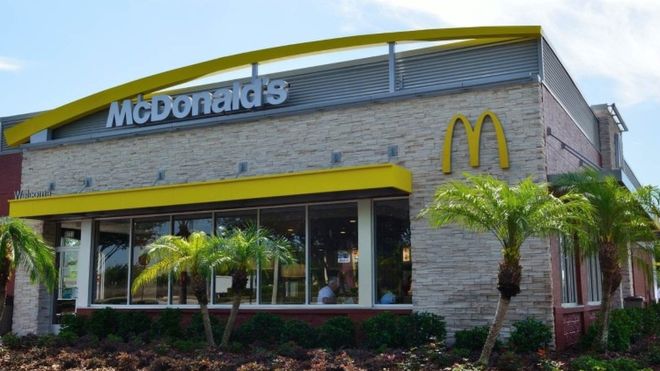
McDonald’s is buying an artificial intelligence start-up to help serve up data-driven meal choices.

The technology developed by Israeli start-up Dynamic Yield can automatically change menus depending on the weather, time of day and traffic.

McDonald’s is reported to be paying $300m (£227m) for the tech firm.

Number-plate recognition would also allow it to offer customers at drive-throughs their usual food order, McDonald’s told Wired.

Dynamic Yield’s technology would allow AI to determine what products are promoted, for example automatically suggesting McFlurry ice cream on hot days, or telling customers which items are already proving popular at that particular restaurant that day.

Most McDonald’s outlets in the US are drive-throughs which is where the restaurant chain is planning to roll out the technology first.

“It can know time of day, it can know weather. We can also have it understand what our service times are so it only suggests items that are easier to make in our peak hours,” said McDonald’s chief executive Steve Easterbrook.

The ultimate aim was to provide a “much more personalised experience” and to be able to suggest additional items based on the customer’s initial order, he added.

Mr Easterbrook said McDonald’s would use the technology to make the most of data gathered from serving the firm’s 68 million fast-food customers and that it would be integrated into the app and the self-order kiosks already in stores.

Dynamic Yield, based in Tel Aviv, has designed algorithms that use shopping patterns and past purchases to suggest what items you will buy next and produced machine learning systems for other firms including Ikea, Office and William Hill.

Boeing explains its 737 Max software update

A Boeing 737 MAX 8 operated by Air Canada comes in for a landing Wednesday, March 27, 2019, at Boeing Field in Seattle. The Federal Aviation Administration plans to revamp oversight of airplane development after the two deadly crashes of 737 Max 8 airplanes, according to testimony prepared for a Capitol Hill hearing on Wednesday.

It should rely on more accurate data and won’t be as aggressive.

Boeing has detailed its promised software update for 737 Max jets, and it largely matches up with the rumored safety improvements that could reduce the likelihood of a crash. The anti-stall Maneuvering Characteristics Augmentation System (MCAS) will now compare the data from both of the 737’s angle-of-attack sensors, rather than relying on one. If there’s a disagreement of 5.5 degrees or more, MCAS won’t kick in. The software will also reduce its input during an incident, and won’t apply so much input to the stabilizers that the crew can’t counteract it.

The aircraft maker has also produced a new PC-based training program to help pilots better understand MCAS and how to react when the technology is in use. It’s further promising to deliver a previously optional safety feature available for free.

The FAA still has to approve the fix, and it’ll take time after that to both install the update, test it and train crews on the changes. This also doesn’t include foreign airlines that will want to conduct their own retrofits and testing, which could take considerably longer. It may take several weeks before you see the 737 Max fly again in the US, and months worldwide.

Not that Boeing will have much choice but to take its time. The Justice Department is investigating multiple concerns about the 737 Max family in the wake of crashes in Indonesia and Ethiopia, such as the decisions to make safety features optional and to leave much of the safety certification process to Boeing. It will have to show that its proposed software and training fixes should be enough to minimize the potential for future tragedies, and might have to make further accommodations if officials aren’t satisfied.

Two stocks To Watch For Long-Term Investors: Eli Lilly and Company (LLY), International Game Technology PLC (IGT)
Eli Lilly & Co. signage is displayed outside the company’s office in La Jolla, California, U.S., on Tuesday, Aug. 23, 2011. Eli Lilly has developed productive alliances and partnerships that advance the capacity to develop innovative medicines at lower cost.

Eli Lilly and Company (NYSE: LLY) experienced a high price of $132.13 with a low value of $129.7 at the end of the last trading session, which followed after a gain of 0.89% and settled at $131.02 during the course of the last 24 hours for the day. Respectfully, the company now has 1.04B shares after the latest changes, so the present market capitalization sits at $135.67B. The trading volume of Eli Lilly and Company shares went over 5,595,408 in a single day during the last trading session in comparison to the average volume of LLY, usually circulating around 16.96M.

During the course of the last year, the stock has touched a high of $130.75 and a low of $74.65, which as a result has the increased attention of top market experts who are tracking the progress of the asset as it is getting closer to a notable historic high price or low value.

Looking at the latest analyst forecasts, the current earnings-per-share (EPS) consensus estimate is sitting at $6.52 per share. In the preceding year, the company reportedly generated EPS of $3.30 per share of its common stock. The profitability indicators are showing that this organization has an operating margin of 15.20%, a profit margin of 13.20%, and a gross margin of 73.80%.

If we were to do a comparison between the current price and its previous movement in the market, we can easily conclude that the price went to a positive change, going up by +4.43 in the past five trading days, which resulted in a percentage change of +3.50% and a moving average of 129.13. In the past 20 days, its price changed by +6.35, which means that the stock’s moving average was 126.61. Looking back at a cycle of the last 50 days, shares of LLY changed by $+14.84 (which is +12.77%) and demonstrated a moving average of 122.17. Meanwhile, this stock’s MACD Oscillator was 2.56 over the past 9 days, and 3.38 over the past two weeks, also marking 3.11 in the period of the last 20 days.

International Game Technology PLC (NYSE:IGT)’s shares demonstrated a change of 1.17% during the most recent trading session, ending the trading day at the price of $13.01 with a 24-hour trading volume that reached 2,527,928 – compared to its average trading volume of as 3.37M, as recorded over the past three months. With that closing price, the market capitalization of this company is now sitting at $2.76B. The moving average for last 20 days of International Game Technology PLC is at -12.06%, while the average went down by -16.56% during the last 50 days with -30.08% recorded during the last 200 days. Additionally, this stock’s distance from its 52-week high price is currently down by -58.03%, while it’s sitting 2.12% away from its 52-week low price.

When you are considering investing in stocks, it is wise to consider counting in Wall Street analysts’ target prices, which should help you place a more profitable investment. The price targets can provide you with an idea of the predicted movement of stocks you are interested in. At the moment, the price target set for International Game Technology PLC is $21.94. It’s also helpful to look at the average analyst recommendation score – which is provided on a scale of 1 to 5 where 1 is “strong buy”, 2 is “buy”, 3 is “hold”, 4 is “sell” and 5 is a “strong sell”. Right now, the average analyst recommendation for IGT stands at 1.80 , which indicates that analysts recommend investors to Strong Buy their shares of IGT until the stock approaches its target price.

Traders use the ATR to analyze potential exit and entry points, as it represents a useful tool in almost any trading strategy. ATR for this stock is sitting at 0.51. Beta tells us about a stock’s volatility, also known as its systematic risk, compared to the market overall. The current beta value for IGT is 1.29, while for the past seven days, this stock’s volatility was 2.94%, also recording 3.41% for the past 30-day period.

Professionals on Wall Street also frequently check the Relative Strength Index (RSI) of a potential investment, which tells us the speed and change of a stock’s price movement in the market. RSI is expressed on a scale of 0 to 100. If the indicators are set higher above 70, then the RSI factors are indicating that the stocks are overbought. The factors will indicate that a stock is oversold if the result is set below 30. Right now, International Game Technology PLC (IGT) has an RSI of 29.98 – indicating that the asset is being oversold.

Two stocks To Watch For Long-Term Investors: Encana Corporation (ECA), NVIDIA Corporation (NVDA)
Encana Corporation (NYSE: ECA) experienced a high price of $7.21 with a low value of $7.02 at the end of the last trading session, which followed after a gain of 4.19% and settled at $7.21 during the course of the last 24 hours for the day. Respectfully, the company now has 1.57B shares after the latest changes, so the present market capitalization sits at $11.33B. The trading volume of Encana Corporation shares went over 22,271,100 in a single day during the last trading session in comparison to the average volume of ECA, usually circulating around 32.78M.

During the course of the last year, the stock has touched a high of $14.28 and a low of $5.00, which as a result has the increased attention of top market experts who are tracking the progress of the asset as it is getting closer to a notable historic high price or low value.

Looking at the latest analyst forecasts, the current earnings-per-share (EPS) consensus estimate is sitting at $0.93 per share. In the preceding year, the company reportedly generated EPS of $1.12 per share of its common stock. The profitability indicators are showing that this organization has an operating margin of 28.50%, a profit margin of 18.00%, and a gross margin of 71.40%.

If we were to do a comparison between the current price and its previous movement in the market, we can easily conclude that the price went to a negative change, going down by -0.14 in the past five trading days, which resulted in a percentage change of -1.90% and a moving average of 7.21. In the past 20 days, its price changed by +0.26, which means that the stock’s moving average was 7.15. Looking back at a cycle of the last 50 days, shares of ECA changed by $+0.47 (which is +6.97%) and demonstrated a moving average of 6.92. Meanwhile, this stock’s MACD Oscillator was -0.21 over the past 9 days, and -0.10 over the past two weeks, also marking -0.10 in the period of the last 20 days.

NVIDIA Corporation (NASDAQ:NVDA)’s shares demonstrated a change of 1.78% during the most recent trading session, ending the trading day at the price of $176.87 with a 24-hour trading volume that reached 17,487,848 – compared to its average trading volume of as 16.68M, as recorded over the past three months. With that closing price, the market capitalization of this company is now sitting at $111.07B. The moving average for last 20 days of NVIDIA Corporation is at 8.16%, while the average went up by 13.56% during the last 50 days with -14.83% recorded during the last 200 days. Additionally, this stock’s distance from its 52-week high price is currently down by -39.59%, while it’s sitting 42.11% away from its 52-week low price.

When you are considering investing in stocks, it is wise to consider counting in Wall Street analysts’ target prices, which should help you place a more profitable investment. The price targets can provide you with an idea of the predicted movement of stocks you are interested in. At the moment, the price target set for NVIDIA Corporation is $186.38. It’s also helpful to look at the average analyst recommendation score – which is provided on a scale of 1 to 5 where 1 is “strong buy”, 2 is “buy”, 3 is “hold”, 4 is “sell” and 5 is a “strong sell”. Right now, the average analyst recommendation for NVDA stands at 2.20, which indicates that analysts recommend investors to Buy their shares of NVDA until the stock approaches its target price.

Traders use the ATR to analyze potential exit and entry points, as it represents a useful tool in almost any trading strategy. ATR for this stock is sitting at 6.41. Beta tells us about a stock’s volatility, also known as its systematic risk, compared to the market overall. The current beta value for NVDA is 1.91, while for the past seven days, this stock’s volatility was 4.39%, also recording 3.57% for the past 30-day period.

Professionals on Wall Street also frequently check the Relative Strength Index (RSI) of a potential investment, which tells us the speed and change of a stock’s price movement in the market. RSI is expressed on a scale of 0 to 100. If the indicators are set higher above 70, then the RSI factors are indicating that the stocks are overbought. The factors will indicate that a stock is oversold if the result is set below 30. Right now, NVIDIA Corporation (NVDA) has an RSI of 60.54 – indicating that the asset is being neither overbought nor oversold.