
Archives for October 13, 2018

It took Warren Buffett 20 months to sell his home—how to avoid that same fate

Homeowners on the West Coast typically won’t have much trouble off-loading their properties in today’s market. Unless, apparently, they’re Warren Buffett.

The iconic investor and Berkshire Hathaway BRK.A, +0.65% chairman struggled for more than 1.5 years to sell his home in the gated community Emerald Bay, near Laguna Beach, Calif. But he finally did so, The Wall Street Journal reported Friday — for nearly a third less than his original asking price.

Buffett purchased the house, which was built in 1936, for $150,000 in 1971 and put it on the market in February 2017 for $11 million, Bloomberg reported. Last month, he decided to lower the listing price to $7.9 million, after it continued to languish on the market.

The home sold below asking, at just $7.5 million.

The property’s listing agent declined to identify the buyer. “I feel very good about the couple who bought the house and hope their family gets as much enjoyment from it as our family did,” Buffett said in a statement following the sale.

The house has plenty of selling points, including a nearly 3,600-square-feet interior and ocean views. Some ads for the property have even played up the Buffett connection with listing photos that include his beloved Coca-Cola KO, +0.09% and The Wall Street Journal (a newspaper that’s owned by News Corp., the same company that owns MarketWatch).

So why did it take this long for a buyer to bite? There are lessons for every homeowner:

Buffett priced it too high, even for a fancy property

For starters, it appears that Buffett stumbled on one of the most common pitfalls that can cause a home to linger on the market for much longer than anticipated: He overpriced it. The median price for homes in the same ZIP code as Buffett’s property is roughly $1.88 million, according to data from real estate firm Redfin. And homes in that area stay on the market for a median of 226 days. Homes in Emerald Bay are listed for a median price of $6.5 million, according to Realtor.com (Realtor.com is operated by News Corp NWSA, +0.94% subsidiary Move Inc.)

So, even at the home’s new listing price of $7.9 million, it is still well above the median price for the area at a time when home prices are starting to waver across the country.

It’s not unusual for more expensive homes to stay on the market longer because there’s typically a smaller pool of potential buyers out there, said Daren Blomquist, senior vice president of communications at Attom Data Solutions, a real-estate data firm in Irvine, Calif. Still, the sheer length of time Buffett’s home has been up for sale suggests the list price doesn’t fit with buyers’ expectations. And the longer the house remains unsold, the more wary many buyers become.

Interest rates are on their way up, which makes buyers skittish

Other developments in recent months have also worked against high-end home sellers like Buffet though, Blomquist said. “Interest rates have ticked up,” he said. “This can really magnify the amount you’re paying. That’s one of the factors that has started to slow down some of the higher end markets.”

Additionally, the GOP-led tax reform package reduced the mortgage interest deduction and capped the property tax deduction at just $10,000. Property taxes for a multimillion-dollar home in a high-tax state like California could easily exceed that amount — and that could be making buyers more hesitant, Blomquist said.

There’s no shortage of homes for sale in Laguna Beach

Laguna Beach has also seen an increase in the number of homes on the market. Inventory there grew by 3% over the past year as of February. Nationally, home inventory has dropped 14%, according to Redfin. That makes the market more favorable to buyers, especially those in search of a bargain. In January, just 10% of properties in Buffett’s same ZIP code were sold above the list price, compared with 19% of homes nationally, according to Redfin.

If you’re looking to avoid some of Buffett’s mistakes, here’s what else to keep in mind.

Snoop around other homes for sale in the area — they’re your competition
If a home stays on the market too long, that alone could weigh on buyers’ minds. “They’ll think there’s something wrong with it,” Blomquist said. “That psychology builds on itself the longer it sits on the market.”

To avoid overpricing, experts suggest that sellers check what other homes in the area are selling for, and even consider asking a real-estate agent to show you the inside of those homes.

If your home isn’t selling, “Go see what they’ve got that you don’t,” said Mindy Jensen, the author of “How to Sell Your Home” and the community manager at real-estate website BiggerPockets.

In Buffett’s case, his home lacks many of the upgrades and amenities that buyers expect in Laguna Beach, Redfin RDFN, -1.94% agent Max Black told MarketWatch in March. “At a price tag of $11 million, or just over $3,000 per square foot, luxury buyers will be comparing this property to other non-oceanfront homes with more upgrades that are priced in the $2,200 to $2,400 per square foot range,” Black said.

Don’t expect prospective buyers to have too much imagination

The listing for Buffett’s home shows personal touches that Buffett likes, but non-celebrities shouldn’t stage their homes this way, Jensen said. “Buyers have no imagination,” she said. “If they walk in and see you’ve got a bright green wall, they could say, ‘I hate that, so I won’t buy this house.’” Keep paint and finishes neutral, Jensen said. A few family photos are fine, but subtlety is good.

Some cosmetic changes can also help. Even if an entire kitchen renovation isn’t realistic, smaller improvements like fixing broken door knobs, or replacing outdated hardware on cabinets are good moves.

A fresh paint job is another easy upgrade, Jensen said. For example, homes with blue bathrooms, specifically lighter shades, sold for $5,400 more than expected, according to a paint color analysis from the real estate website Zillow ZG, +1.10% “Paint is one of the cheapest things you can do to fix your house,” Jensen said.

Replacing the roof, on the other hand, isn’t likely to up the home’s value very much, relative to how much it will cost the seller.

Try some psychological warfare: Consider underpricing the home

If home sellers want to get their property off the market as quickly as they can, they’ll need to be aggressive with their pricing. And one sure-fire way of doing this is by pricing the property so it’s more affordable than other comparable listings.

Sellers should look for specific, psychological milestones when it comes to prices, Blomquist said. In other words, if the average listing price is $200,000, a seller may see more interest in the property if it’s priced at $190,000.

While this strategy is sure to speed the process along in nearly any market, in a competitive one it could also pay off — literally. “If people will flock to what they see as a bargain, they may bid up the price until it matches the desired sales price,” Blomquist said.


10 Things Everyone Must Know About Taxes

FILING TAXES CAN FEEL daunting, regardless of your income bracket, filing status or familiarity with current rules and regulations.

Fortunately, getting important documents prepped and learning basic concepts, including how taxes are assessed and collected, can help make the process easier to navigate. After all, even if taxes aren’t your favorite subject, failing to understand the tax code can mean missing out on beneficial breaks and deductions or getting slapped with late-payment charges.

Stay prepared ahead of tax season by learning these 10 crucial principles and best practices.

Failing to file will cost you more than failing to pay your taxes. “You need to file your return on time,” explains Bill Smith, managing director of financial consulting firm CBIZ MHM’s National Tax Office.

People may be hesitant to file if they can’t pay their bill, but you can always request a payment plan. What’s more, the penalty for failing to file is significantly more than the penalty for failing to pay. The failure-to-file penalty is equal to 5 percent of the unpaid tax and can be assessed for up to five months. Conversely, the failure-to-pay penalty is 0.5 percent of the tax due and is assessed monthly.

Refunds are forfeited after three years. Some people don’t bother filing their federal return because they are short on time and know the government owes them money. While there is no failure-to-file penalty on returns that are due a refund, procrastinating can still cost you. If you wait too long, you won’t be able to claim the refund at all. “Once you get three years out, you’re not entitled to it anymore,” Smith says.

Recent tax changes aren’t permanent. The Tax Cuts and Jobs Act was passed with much fanfare last year and makes significant changes to the tax code starting with the 2018 tax year. It creates new tax brackets and increases the child tax credit and standard deductions, while eliminating personal exemptions.

Don’t get too attached to these changes, though. “In 2026, the law sunsets, and we go back to the old regime we had before,” says Pierre Vogelbacher, wealth strategy market manager at financial firm PNC Wealth Management. That is, unless Congress votes to extend the law before then.

You may not need to itemize your deductions. Taxpayers of all filing statuses will see their standard deductions nearly double when they file returns next year, thanks to the Tax Cuts and Jobs Act. The law increases the standard deduction for married couples filing jointly from $12,700 to $24,000. For single taxpayers, the deduction will increase from $6,350 to $12,000. Heads of households will see their deduction increase from $9,350 in 2017 to $18,000 in 2018.

“That’s going to knock a whole lot of people out of itemizing deductions,” Smith says. There will be no need to track medical bills or tally receipts from unreimbursed business expenses since the likelihood of exceeding the standard deduction will be low for many families.

Itemized deductions aren’t the only way to get a tax break on charitable gifts. One perk of charitable giving has been the ability to write off eligible donations on itemized deductions. With the increased standard deduction, that may no longer be possible for many taxpayers.

People can still get a tax break for charitable contributions through. One way is for retirees to direct a portion of their required minimum distribution, known as an RMD, to a nonprofit organization. When seniors turn age 70 ½, they are required to take an RMD from traditional IRA and 401(k) accounts, even if they don’t need the money. This money is taxable and the added income may push a retiree into a higher tax bracket.

To avoid this problem, “You can give a portion of your required minimum distribution to charity and then you aren’t taxed on that amount,” Vogelbacher says. The money must go directly from your retirement account to the charity for this strategy to work.

Donating stock is another way to minimize taxes with a gift to charity. The giver avoids capital gains tax on the appreciated value of the stock while a tax-exempt nonprofit can sell equities without having to foot a tax bill.

Not all your income is taxable. Eric Bronnenkant, CPA and Head of Tax at online advisory firm Betterment, says people should know not all the money they receive throughout the year is taxable. Financial gifts of up to $15,000, life insurance proceeds and inherited money are all examples of money not subject to federal income tax.

There are plenty of ways to reduce your taxable income this year. Save your money strategically, and you may be able to avoid paying taxes on a significant portion of your income.

“There are a variety of tax-advantaged accounts for a number of purposes,” Bronnenkant says. Retirement accounts may be best known, and employees can deduct up to $18,500 deposited in a traditional 401(k) account in 2018. Those age 50 and older can deduct an additional $6,000 in catch-up contributions. Those without an employer-sponsored retirement plan can deduct $5,500 in contributions made to a traditional IRA, with an additional $1,000 in catch-up contributions allowed for those age 50 and older.

Taxpayers who have a qualified high-deductible health insurance plan can open a health savings account and receive a deduction for money deposited there. Those with an individual health plan are eligible to make up to $3,450 in deductible donations in 2018 while people with a family health plan can deduct up to $6,900 placed in an HSA this year.

Another way to reduce taxes is with a 529 college savings plan. While contributions aren’t eligible for a federal tax deduction, they may be deductible on some state tax forms.

Taxes should be part of every retirement planning discussion. Part of planning for retirement should be planning for taxes. Some money, such as funds from traditional retirement accounts, is taxable in retirement. However, cash from Roth accounts can be withdrawn tax-free. Meanwhile, Social Security benefits can be partially taxed once an individual reaches $25,000 in combined income or a couple has $32,000 in combined income.

“Look at the different buckets you have and decide where you’re going to take your assets,” Vogelbacher says. Retirees want to plan their withdrawals carefully to avoid inadvertently pushing themselves into a higher tax bracket.

Tax professionals can help navigate complex situations. Don’t leave money on the table. Make sure you’ve claimed all possible deductions by using a CPA or professional tax preparer. This may be especially important for those with investments or business owners.

For instance, Bronnenkant points to a new qualified business income deduction. Not all business owners will be eligible, but as a 20 percent deduction, it’s worth taking the time to know for sure. “It’s important to go through the process and see if you qualify,” Bronnenkant says.

Filing your own returns isn’t hard. While tax professionals have their place, Smith says average taxpayers should have no problem filing their return on their own. “There’s a lot more fear of filing taxes than is really warranted,” he says.

Online tax preparation software makes it simple to enter data from W-2 forms and answer basic tax questions. And some providers also offer free filing services to those with annual incomes below $66,000 thanks to the IRS Free File program.

How Does Your Net Worth Compare to Other People Your Age?

It’s challenging to paint a picture of your overall financial health, because there are so many factors involved. How much do you have saved for retirement? How much debt are you carrying? Do you have an emergency fund?

The one figure many people point to, though, is your net worth — that is, what you own minus what you owe. Your net worth accounts for your property, savings, and debt, so it can give you a decent idea of where you stand financially.

To calculate your net worth, simply add up everything you own (your assets) and subtract everything you owe (liabilities). Assets can include home equity, a car, retirement savings, and more, while liabilities include a mortgage, student loans, and other forms of debt. If your net worth is deep in the negative, it means you owe far more than you own, and you need to work on paying down your debts. On the other hand, you may find that you can give yourself a pat on the back if your assets outweigh your liabilities.

The thing about net worth, however, is that there’s no agreed-upon benchmark of success. Your net worth is highly dependent upon your individual circumstances, so it’s tough to set your sights on a certain figure. However, one formula that can help you gauge where you stand is outlined in Thomas Stanley and William Danko’s book The Millionaire Next Door, which states that your ideal net worth is calculated by multiplying your age by your pre-tax annual income and dividing the result by 10. So if you’re 40 years old with an annual salary of $50,000, you should be aiming for a net worth of around $200,000.

Even if you have a net worth goal in mind, it’s human nature to measure yourself against others. Although it’s important not to focus too much on keeping up with the Joneses, sometimes it’s helpful to see how you compare to others in your age bracket.

Your net worth: How it compares to others

According to the Federal Reserve’s 2016 Survey of Consumer Finances (the latest one released), the average U.S. household net worth was $692,100.

That number may come as a shock, but it doesn’t tell the entire story: It’s skewed by super-wealthy households that are worth millions of dollars. The median figure paints a more accurate picture of the typical American family, because it’s smack-dab in the middle; half of households are worth more, and half are worth less. The Federal Reserve found that the median U.S. household’s net worth was around $97,300.

The survey also broke the results down by age, ranging from those under 35 years old to those over 75 years old:

If your net worth doesn’t quite amount to what others your age are worth, don’t get discouraged; it doesn’t necessarily mean that you’re off track financially. Rather, there are other things to consider to get a better idea of your overall financial health.

Other factors that are more important than net worth

Your net worth doesn’t portray your entire financial picture. For example, if you recently bought a house, you may owe hundreds of thousands of dollars on your mortgage — and you may have a negative net worth. But that doesn’t mean you’re necessarily worse off than someone who’s renting, has no mortgage, and yet struggles to make ends meet.

That’s why it’s more important to look at the bigger picture. A single number can’t tell you everything you need to know about your finances, but by looking at a variety of factors, you can get a better understanding of where you need to improve.

For example, first look at the types of liabilities you have. Things like mortgages, car loans, student loans, and credit card debt are all liabilities because you owe money. However, not all types of debt are created equal. Owing $100,000 on a mortgage, for instance, is very different from owing $100,000 in credit card debt. High-interest credit card debt, in particular, is one of the worst types of liabilities to have, because it can cost you thousands of dollars in interest alone, and once it’s paid off, you’ll have little to show for it (unlike a mortgage, for example, which allows you to obtain a home and build equity as you pay down the debt). So by reducing the “bad” types of liabilities first, you can improve your overall financial health.

Your debt-to-income ratio is another important figure to consider. It’s easy to fall into the trap of thinking that once you earn more money, your net worth will increase as well. That’s not always the case, though — in fact, a quarter of Americans earning $150,000 or more per year say they’re living paycheck to paycheck, according to a 2015 Nielsen Global Consumer Insights survey. What’s more important than income alone, then, is how your income compares to how much you’re spending each month.

To calculate your debt-to-income ratio, add up how much you spend each month repaying your debt — this includes your mortgage, car loans, personal loans, student loans, credit card debt, etc. Then divide that number by your gross monthly income. For example, if you’re paying $1,000 per month toward your mortgage, $200 per month toward your car loan, and $300 per month toward credit card debt, your total monthly debt payments amount to $1,500. If your gross monthly income is $3,500, divide $1,500 by $3,500, and your debt-to-income ratio is around 43%.

In general, you should aim for a ratio of around 20% or less. If you’re trying to get a mortgage, most lenders will look for a ratio of less than 36% (though they may go higher if you have a strong credit score). A ratio above 50%, though, is typically a red flag, because it means more than half your income is going toward debt payments each month.

Net worth is an important financial figure to understand, but it’s not everything. There’s more to your overall financial health than just one number, so it’s important to look at the big picture to get a more accurate idea of how you’re doing.

After Hurricane Michael, what homeowners need to know about disaster insurance

Homeowners picking up the pieces from Hurricane Michael will quickly learn an important lesson: not all hurricane-related damage is covered by home insurance.

Before making landfall Wednesday, Michael rapidly intensified to an extremely strong storm packing 155 mile-per-hour winds, just shy of Category 5 status. The storm ranked as the third-most intense hurricane to hit the continental United States, according to Accuweather, and was the strongest storm to ever hit the Florida Panhandle.

Towns and cities along the Panhandle coast were left in ruins, and damage extended well inland into southern Georgia. The storm’s high winds stripped roofs and caused trees to fall on homes and cars. Coastal communities were walloped by a massive storm surge, which forecasters predicted could reach as high as nine to 13 feet before the storm.

For homeowners, what precisely caused the damage to their home will prove important for insurance purposes, because coverage will depend on how the damage was caused. During a hurricane, if high winds cause roof damage that leads to significant water accumulation within the house, insurance will likely cover it. But if a nearby river crests because of the heavy rainfall and then causes flooding, the damage to homes will only be covered if the owners have flood insurance.

That’s why most homeowners in the path of September’s Hurricane Florence’s torrential rains would have been better off if their home had been hit by a wildfire or volcanic eruption — at least from an insurance perspective.

Damage caused by flooding isn’t covered by standard home insurance policies. Only homeowners who bought separate flood insurance for their homes were covered if water from Florence damaged their house. And there weren’t many people in that boat.

Florence caused between $20 billion and $30 billion in losses to both commercial and residential properties across the Southeast due to flood and wind damages, according to estimates from property data firm CoreLogic CLGX, +1.31%

Most homeowners affected by Florence will be stuck footing the bill: CoreLogic also estimated that 85% of the losses to residential properties were uninsured. Before the storm hit, actuarial firm Milliman estimated that fewer than 10% of households in North Carolina had flood insurance.

A similar refrain could now play out because of Hurricane Michael. When Hurricane Irma struck Florida last year, only 14% of the 3.3 million households in the nine counties affected by the disaster had flood insurance coverage, according to data from Pew Charitable Trusts. That’s in spite of the fact that Florida households comprise 35% of policies under the National Flood Insurance Program.

Even when insurance does cover the damage from a certain catastrophe, deductibles are still at play. Hurricane deductibles vary from policy to policy, but are often assessed as a percentage of the home’s overall value.

Coverage for other disasters operates similarly. In volcanic eruptions, damage caused by lava flows or resulting fires is covered by a standard homeowner’s policy, but if the eruption causes seismic activity, homeowners will not be reimbursed unless they have purchased a separate earthquake policy.

Buying additional insurance policies for disasters like floods and earthquakes might seem like a no-brainer, but it’s an expensive proposition. “They have to do a cost benefit analysis,” said Michael Crowe, co-founder and CEO of Clearsurance, a site where consumers can review and compare insurance companies.

The average annual premium for a policy through the National Flood Insurance Program was $878 as of April 2017. But flood insurance premiums can easily cost thousands of dollars in regions that are determined to be at the highest risk of flooding.

But flooding is just one type of natural disaster that isn’t covered by standard home insurance policies. And in the case of disasters like hurricanes, where damage can be caused by a variety of factors including wind, rain and storm surge, it can quickly get confusing—and frustrating— for homeowners who are trying to figure out whether their insurance policy covers certain damage.

Here is what homeowners need to know about insurance and natural disasters:

What is covered under a standard homeowner’s insurance policy

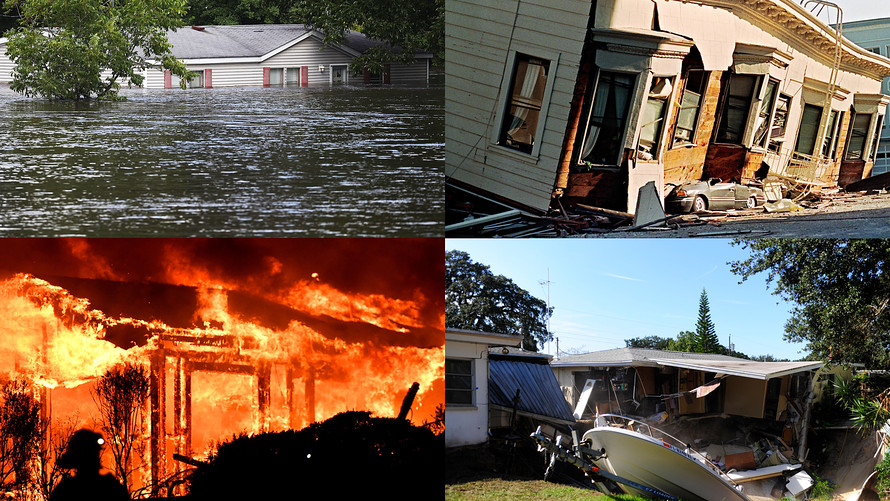
Some natural disasters are always covered by homeowner’s insurance, including wildfires, tornadoes and hail storms. But other natural disasters are never or rarely covered under a standard homeowner’s insurance policy. They generally fall into two categories: floods and “earth movements.”

The first category comprises disasters caused by rising water, which includes everything from floods caused by extensive rainfall and hurricane-induced storm surges to dam failures and tsunamis. “Earth movements” include disasters such as earthquakes, landslides and sinkholes.

Unfortunately, many Americans are unaware that these disasters are not covered by a standard homeowner’s policy, according to the Insurance Information Institute.

Certain natural disaster typically aren’t covered because of the level of the destruction they create, said Lynne McChristian, a spokeswoman for the Insurance Information Institute and executive director of the Center for Risk Management Education and Research at Florida State University.

With these disasters, “the damage is usually so widespread, and it’s typically a total loss,” McChristian said. “Insurance companies can’t price it appropriately to make it a viable line of business for them.”

The government provides flood insurance

In the case of insurance for flooding, the federal government has stepped in. The National Flood Insurance Program was created in 1968 after insurance companies struggled to pay off claims following a slew of floods in the 1950s. Homeowners have the option to buy flood insurance through this program or to get a private insurance policy. In certain cases, homeowners may be required to purchase flood insurance by their mortgage lender if their home is located within a flood zone.

Private flood insurance now accounts for roughly 15% of all flood premiums nationwide, according to a March report from Insurance Journal. And for many homeowners, a policy from a private insurer rather than through the federal insurance program could be cheaper. A July 2017 briefing from Milliman found that private flood policies would have lower premiums for 77% of all single-family homes in Florida, 69% in Louisiana and 92% in Texas.

Earthquakes

Similarly, homeowners will need to purchase a separate policy or a rider to their standard home insurance policy from a private insurer to be covered for an earthquake. California residents also have the option to purchase coverage through the California Earthquake Authority. That said, if an earthquake causes a house fire, some damage might be covered by the standard policy alone.

Sinkholes

As for sinkholes, coverage options vary from state to state. A standard home insurance policy may cover minor damage caused by a sinkhole — but catastrophic damage (generally defined as damage to more than half of the structure) is excluded. People can either get sinkhole insurance in the form of a standalone policy or an endorsement to the standard insurance policy, depending on where they live.

Tennessee and Florida require insurers to offer optional sinkhole coverage. Insurers in Florida are also required to provide insurance for “catastrophic ground cover collapse” through their standard policies.

Did the homeowner take care of the property?

The property’s upkeep can also play a role in whether or not damage caused by a storm or other natural disaster is covered. For instance, if winter storms cause an ice dam to form on the roof of the home and the owner is not proactive about removing it, the insurer may choose to deny coverage for water damage.

You have some options if you skip insurance

If homeowners don’t buy specialized insurance coverage and then get hit by some sort of disaster, they do have some options to offset their losses. They can get a grant from the Federal Emergency Management Agency or a loan from the Small Business Administration.

“Those are not designed to bring you back to a pre-disaster condition — they’re designed just to get you back on your feet,” McChristian said. “Insurance is designed to get you back to where you were before the disaster occurred.”

How to decide whether you need coverage

Earthquakes have caused damaged in all 50 states at some point since 1900, according to the Insurance Information Institute.

For starters, homeowners need to consider whether or not they are at risk. They should check government flood zone maps. They are generally available from county governments, or you can search by address on the FEMA website. But they aren’t foolproof because they are only periodically updated.

Other factors to consider include the property’s elevation (if it’s at or just a few feet above sea level it’s more prone to flooding) and whether there has been a lot of construction in the area. This could displace vegetation that would soak up rainfall and prevent flooding.

As for earthquakes, homeowners shouldn’t assume they’re not at risk just because they don’t live on the West Coast. Earthquakes have caused damaged in all 50 states at some point since 1900, according to the Insurance Information Institute (a trade group that of course has a vested interest in people getting insurance). And fracking for oil and natural gas has led to seismic activity in parts of the country that had never before experienced it.

How to get to the front of the line when you need help

Regardless of whether or not a homeowner has insurance coverage for a specific natural disaster, getting their property assessed is critical in beginning the rebuilding process.

Following a natural disaster, a consumer’s first step should be to contact their insurance agent or company immediately. That is critical because insurance claims are handled on a triage basis, McChristian said.

“Those with the most damage get to the front of the line because those people have the most need for recovery assistance,” McChristian said.

By clarifying how to file a claim and conveying the state of their property, homeowners can improve the chances of having their case handled more quickly by their insurer. Homeowners should also learn the ins and outs of how to file their claim, including what information is needed and how long they have to file. Now is also the time to determine what their policy’s deductible is.

Make a head-start on assessing damage

The insurance company will send its own adjuster free of charge to inspect the property and assess the total cost of the damage. Homeowners can take steps to prepare for this by documenting what was damaged or destroyed by the natural disaster, getting bids from contractors and keeping track of receipts for any expenses they incur following the storm. Homeowners shouldn’t hesitate to make temporary repairs to protect their property from further damage.

Homeowners shouldn’t hesitate to make temporary repairs to protect their property from further damage.
A pricier option: Hire a third-party insurance adjuster to assess their property. Given the backlog insurers will experience following widespread disasters, it can take a while to receive a payout. To expedite this process, a homeowner can choose to hire an independent or public adjuster to assess their property.

Studies have shown that hiring public adjusters leads to higher insurance settlements. But these professionals don’t come cheap — they generally charge a fee that’s anywhere from 10% to 20% of the insurance settlement. And it’s critical to hire a reputable professional. (Check the websites of the National Association of Independent Insurance Adjusters and the National Association of Public Insurance Adjusters.)

Always have someone look at damaged property

And even if homeowners aren’t covered for flood insurance, they should still have their insurance company assess their property and whatever damage occurred.

Crowe has experienced this firsthand. In 2006, an extended period of rainfall in Newburyport, Mass., where Crowe and his family lived, caused their newly remodeled basement to flood. However, their insurance policy did not include flood coverage. He thought he would have to pay for all the damage.

But when insurance adjusters inspected the property, they noted that the basement’s sump pump — designed to prevent water accumulation — had failed.

In other words, he got lucky. The insurance company categorized the damage as the result of a mechanical failure rather than a flood, so the company covered the damage.

“I thought to myself, ‘I’m really fortunate to have insider knowledge,’” Crowe said.