Archives for November 17, 2017

Stitch Fix shares spike in IPO after opening at $16.90

  • Stitch Fix shares debut on the Nasdaq at $16.90, having priced at $15 the previous night.
  • The online retail service raised $120 million in a downsized IPO that priced below its indicated range of $18 to $20.
  • Following troubles at Blue Apron and Snap, which have tumbled since going public in 2017, analysts and investors have voiced concerns about Stitch Fix’s ability to stay profitable.
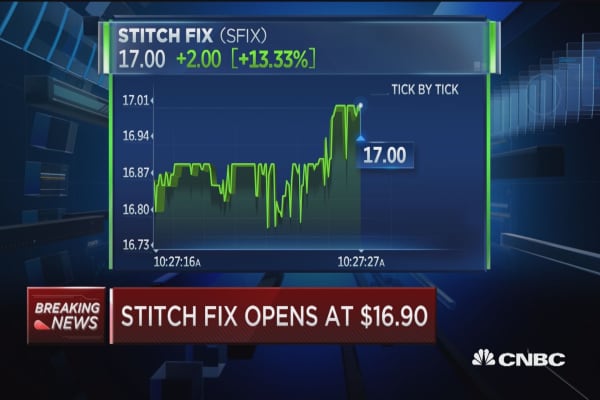
Stitch Fix opens at $16.90

Stitch Fix opens at $16.90  

Stitch Fix shares began trading on the Nasdaq stock exchange at $16.90 Friday morning, having priced at $15 the night before.

The stock briefly skyrocketed more than 20 percent on its initial public offering before settling to a gain of about 15 percent by midday.

Stitch Fix raised $120 million Thursday evening in a downsized IPO that priced below its indicated range of $18 to $20. The online retail service had originally planned to sell 10 million shares in the offering, though only sold 8 million.

Investors had demanded a discount amid concerns over the company’s profitability and transparency of its financial metrics, a source familiar with the situation said.

Stock jumps from IPO prices are particularly important to institutional investors toward the end of the year, as funds close out their books. Investors were skittish about potential fourth-quarter surprises, a trend that has been set by Snap and Blue Apron, the source added.

An opening price of $16.90 values Stitch Fix at roughly $1.63 billion. The company was last valued at $2 billion, when founder and CEO Katrina Lake sold off about $1 million of her stake late last year.

“I feel like there’s a little bit of hair on this one,” John Martinko, co-president at Drexel Hamilton, told CNBC’s “Worldwide Exchange” on Friday morning. “E-commerce in a box is still a little bit of an overhang from Blue Apron. But I believe in this company. … The stylist and their algorithms makes sense to me.”

Blue Apron and Snap have tumbled since going public in 2017, prompting analysts and investors take a closer look Stitch Fix’s ability to grow and turn a profit.

Further, some say the IPO market is beginning to show signs of fatigueafter rebounding earlier this year.

Stitch Fix is a play on an increasingly popular “subscription box” model, in which customers pay to have regular — often monthly — shipments of goods. These models are attractive because companies can forecast revenue, but many have struggled to balance sales against steep marketing costs.

With Stitch Fix, customers submit size, budget and style preferences before receiving a box of five apparel and accessories items, which can either be purchased or returned. It hopes its personalized service will reach and appeal to more shoppers than a traditional e-retailer.

“This industry is out of date and largely untouched by technology or innovation,” Lake said about retail during an appearance at the Nasdaq on IPO day. “We have an incredible opportunity in doing something totally different.”

Stitch Fix’s few venture-capital investors include Baseline Ventures and Benchmark Capital, which invested in the company at a $300 million valuation in 2014.

Stitch Fix’s Lake, the only woman to lead a tech IPO this year, still owns roughly 15 percent in her company.

Stitch Fix now trades on the Nasdaq under the ticker “SFIX.” Goldman Sachs and JPMorgan were the lead underwriters for this offering.
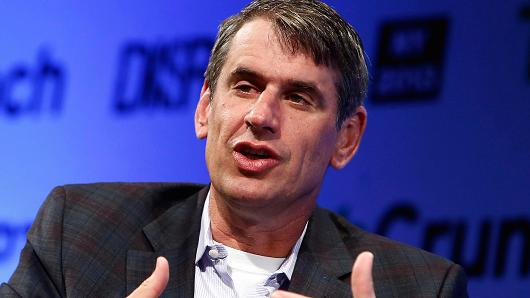
Uber investor Bill Gurley: My firm was ‘on the right side of history’ for ousting Travis Kalanick

  • Bill Gurley is a general partner at Benchmark.
  • His firm was involved in a lawsuit against Uber’s former CEO.
  • Gurley has been outspoken about the state of venture capital on his widely read blog, “Above the Crowd.”

When it comes to Uber, venture capitalist Bill Gurley said he thinks he was on the right side of history.

Gurley is a general partner at Benchmark, a major investor in Uber, and a leader of Uber’s thunderous workplace culture investigation — which led to the exit of co-founder-CEO Travis Kalanick. Benchmark was embroiled in a lawsuit with Kalanick, who is still on the board.

“We reached a point where we felt like the entire company and all its constituencies — drivers, riders, employees, shareholders — were at risk if the company continued to move in the direction it was,” Gurley told CNBC’s “Squawk Alley” on Friday. “We took action that was not easy to take. We’ve suffered some brand hits as a result, but we felt like we were on the right side of history.”

Not everyone agrees. A small shareholder group has demanded that Benchmark exit Uber altogether.

“The two questions we get most often are ‘How could you possibly have done this?’ and ‘Why didn’t you do this sooner?’ and obviously those two are in dark contrast with one another,” Gurley said.

After the conclusion of the internal investigation, which started with sexual harassment investigations and discovered other employee misconduct, Gurley left the board, replaced by Benchmark partner Matt Cohler. But Gurley said Uber’s board is now all on board with an investment from Japanese giant SoftBank.

“2017 has been a very difficult year, and it’s been one where we’ve been working quite diligently behind the scenes,” Gurley said. “We’ve received immense positive feedback from the shareholders.”

Uber’s new CEO, Dara Khosrowshahi, has said he hopes it will go public by 2019. Gurley said that Khosrowshahi has also made an “impact” in negotiations with regulators in London and Brazil, and is a “super mature and sophisticated’ executive.

“I think today, if you ask anyone involved, ‘Are better off because of Dara’s leadership and where we’re going?’, I think they’d all say yes,” Gurley said.

Gurley, who at Benchmark has also invested in companies like Zillow and GrubHub, cut his teeth as a Wall Street analyst covering Amazon’s IPO, as well as companies like Microsoft and Dell. He has been outspoken about the state of venture capital on his widely read blog, “Above the Crowd,” where he advocated for rigorous vetting among start-up investors, and supported public accountability for technology companies.

Benchmark is also a big investor in retail start-up Stitch Fix, which went public on Friday. Stitch Fix shares spiked more than 20 percent as they started trading on Friday, despite the pared-back size of the IPO.

Gurley pointed out that Stitch Fix, unlike many recently public companies, has turned a profit before. He called for an end to the “silly notion” that large tech start-ups should stay private, comparing private start-ups to college football, rather than NFL.

“If you want to succeed, if you want to play at the next level, you have to step it up, and go there,” Gurley said.

Toshiba set to OK $5 billion injection Monday to stay listed-sources

Toshiba Corp <6502.T> will decide on Monday to raise some $5 billion from overseas investors, allowing the troubled conglomerate to remain a publicly traded company even if the sale of a key business is delayed, two people with direct knowledge of the process said.

Toshiba, reeling from the bankruptcy of its U.S. nuclear unit Westinghouse Co in the wake of an accounting scandal, needs to raise 750 billion yen ($6.7 billion) by the end of March to avoid being kicked off the Tokyo Stock Exchange.

The laptops-to-nuclear-reactors company has agreed to sell its prized NAND semiconductor unit for $18 billion, and is planning to sell its TV business and reportedly looking to hive off its personal-computer unit to raise cash.

But with the March deadline looming to avoid delisting and the chip sale threatened by antitrust concerns from China and elsewhere, Toshiba’s board will on Monday approve a plan to raise 600 billion yen ($5.3 billion) by offering shares to a group of overseas investors, the sources said.

In addition, the sources told Reuters, Toshiba will agree to take upfront losses that will allow tax write-offs sufficient to boost its assets back above liabilities for the first time in two years – allowing the firm to remain listed.

Toshiba declined to comment on the plan.

To plug the huge hole in its balance sheet, Toshiba agreed in late September to sell its Toshiba Memory unit to a group led by Bain Capital for $18 billion.

But regulatory reviews globally threaten its ability to close the sale by the March end of the business year, which would put the company in negative net worth for a second year in a row, imperiling its TSE listing.

Without any gains from the chip unit sale, Toshiba forecasts it would post negative net worth of 750 billion yen at the end of March.

The company could use the proceeds from a share allotment to pay all at once the $5.8 billion in parent-company guarantees on Westinghouse’s much-delayed nuclear projects in the United States, one source said.

The current plan is to guarantee payments to two U.S. power utilities over six years. Paying them off in full now would allow Toshiba to book losses that would reduce its tax burden enough to ensure it has the cash to remain listed, the source said.

Meet some people getting rich from bitcoin

For Eddy Zillan’s bar mitzvah in 2012, his parents gave him $5,000 to start an investment fund. They expected him to start dabbling in stocks. Instead, he began buying cryptocurrencies like bitcoin and ethereum.

Eddy saved up another $7,000 from summers spent working at a tennis club and other jobs, adding that to his investment fund for a total $12,000 in principal.

Anybody who has been following cryptocurrencies knows where this story is going: Eddy’s $12,000 investment is now worth well over $500,000, a return exceeding 4,100% in just a few years.

“I don’t know if he’s a prodigy, but he’s close,” says Eddy’s father, David Zillan. Eddy, now 18, is a high school senior in Orange, Ohio, near Cleveland. He hopes to study dentistry next year at Case Western Reserve University. But if that doesn’t work out, he has a Plan B, since he just launched a company that provides tutorials and insights on cryptocurrencies. “Hopefully he’ll be a multimillionaire by the time he’s my age,” says his father, who is 46.

Eddy Zillan, 18, of Orange, Ohio, has amassed well over $500,000 worth of bitcoin and other cryptocurrencies. (Photo courtesy of Eddy Zillan)

Bitcoin and other cryptocurrencies are suddenly the hottest investment since the dot-com bubble, after a stunning surge in value during the last year.

The price of bitcoin, the most well-known cryptocurrency, has soared by more than 700% in 2017. Ethereum is up a mind-boggling 3,900% — and early purchasers are suddenly watching the zeroes multiply on their accounts. Many crypto investors are reluctant to talk about their holdings, since alt-currencies are still associated with illicit activity, and they tend to appeal to non-traditionalists in the first place. But we found some willing to tell us their experiences. There are also plenty of detractors who insist cryptocurrencies are Ponzi schemes or worse. Yet regulators may soon bestow validity on cryptocurrencies by allowing broader investments, such as exchange-traded funds (ETFs), to track their value.

The origins of bitcoin

Bitcoin is a digital payment system launched in 2009 by a person or group using the name Satoshi Nakamoto. A network of coders with powerful computers has slowly “mined” more bitcoin since then by running complex computations that adhere to a set of founding principles, making bitcoin a kind of crowd-sourced currency. The market value of all bitcoin in the world is around $132 billion at current prices, roughly comparable to the current value of McDonald’s (MCD).

Other cryptocurrencies, sometimes referred to as “altcoins,” have emerged as well, including ether, the token of the blockchain network ethereum ($32 billion in market cap), ripple ($9 billion), litecoin ($3.7 billion) and dash ($3.3 billion).

In a recent Yahoo Finance survey, 77% of respondents told us they have never purchased bitcoin — but of those, 11% said they’re planning to, and 38% said they’re thinking about it. As more people buy in, that interest alone could send the crypto rally even higher.